This article contains affiliate links. We may earn a commission at no extra cost to you. See our disclosure.
VS
Both of these are wax-style protectors, not healing balms. The real question isn't which one moisturizes better, it's how they apply and how long the barrier lasts before slush, salt, or a determined tongue wears it off.
Before you click buy, a few things the research we reviewed cannot tell you.
Is Natural Dog Company Paw Soother the same product as PawTection?
No. They're two different Natural Dog Company products. PawTection is the wax-style protection balm covered here, designed as a barrier against snow, salt, and hot pavement. Paw Soother is a moisturizing balm aimed at softening callouses and healing cracked pads. Treeline Review tested both and named Paw Soother 'Best Natural Dog Paw Balm' for healing use, not protection.
How often should I reapply during a walk?
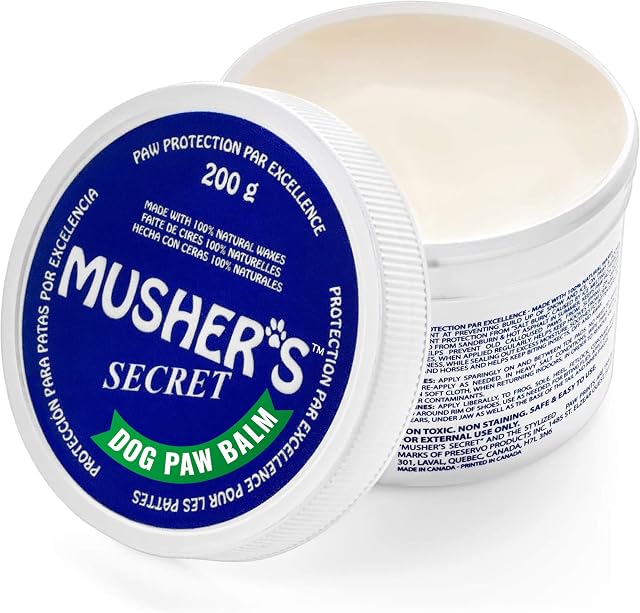
Treeline Review notes Musher's Secret 'needs multiple applications for long outings in snow' and doesn't provide all-day protection in extended winter use. For walks past 30 minutes in heavy slush, plan on a midpoint reapplication or pair the wax with dog boots. PawTection sits more on top of the pad, which Treeline Review describes as limiting its moisturizing benefit but the testing didn't quantify duration on either.
Are these safe if my dog licks them off?
Both are labeled lick-safe. Musher's Secret uses beeswax, carnauba, candelilla wax, vegetable oils, and vitamin E. PawTection uses organic mango butter, cocoa butter, coconut oil, hempseed oil, jojoba, candelilla wax, calendula, and vitamin E. Neither contains the essential oils (tea tree, pennyroyal, wintergreen, eucalyptus) that the ASPCA flags as toxic to dogs. The research we reviewed didn't include long-term ingestion studies; consult your vet if your dog is an aggressive licker.
Will either one make my hardwood floors slippery?
Musher's Secret has direct r/dogs confirmation that it doesn't transfer to laminate floors or carpet and doesn't attract dirt or sand. PawTection has no equivalent sourced data; Treeline Review notes it sits more on top of the paw pad than soaking in, which is the residue mechanism. The manufacturer-recommended fix for any wax is to apply a thin layer and keep the dog still for a few minutes before letting them walk on hard floors.
Should I just use dog boots instead?
For sharp ice, rocks, or sustained sub-freezing exposure, Treeline Review explicitly recommends boots over wax. Wax is for routine winter walks on salted sidewalks and short outings in snow; boots are for terrain that will physically cut or freeze the pad. Many owners use both: wax for daily walks, boots for trails or extreme cold.