Signs Your Dog Needs Probiotics (And Which to Use)
Researched by Sage
This article contains affiliate links. We may earn a commission at no extra cost to you. See our disclosure.

How to Tell If Your Dog Actually Needs a Probiotic
The honest answer is that most dogs showing chronic loose stool, intermittent gas, post-antibiotic digestive changes, persistent paw licking, seasonal skin flares, or stress-triggered GI upset are reasonable candidates for a probiotic trial. As PetMD's vet advisory panel notes, these symptoms can reflect gut microbiome disruption – but they can also reflect more serious underlying conditions. If symptoms are severe or persistent, a vet visit to rule out parasites, infection, or IBD comes first.
Once serious pathology is off the table, probiotics become a sensible next step. The research reviewed here consistently points to the same signs: intermittent loose stool, increased gas or borborygmi, coat condition changes, chronic itching or paw licking, heightened anxious behaviors, and GI disruption following antibiotics or a diet transition. The key is matching the right strain to the right symptom – not just buying whatever has the highest review count.
Matching Probiotic Strains to Specific Symptoms
Not every probiotic strain does the same job. This is the most important thing the supplement marketing on most product labels obscures. Here is how the strains with actual clinical evidence map to observable symptoms, based on data from Cornell University's veterinary college, PetMD's vet panel, the AKC, and WebMD Pets:
- Chronic loose stool or acute diarrhea: Enterococcus faecium SF68 (in FortiFlora) has the strongest clinical research base for stool normalization. Bifidobacterium animalis AHC7 also has specific research backing for acute diarrhea recovery. Lactobacillus acidophilus supports stool quality and frequency.
- Post-antibiotic GI disruption: Multi-strain formulas covering Lactobacillus and Bifidobacterium species provide broader microbiome rebuilding than single-strain products. Proviable's 7+ strain formula is consistently co-recommended with FortiFlora by vets in r/AskVet threads for this scenario.
- Paw licking and seasonal skin flares: Bifidobacterium species support chronic cases and recurrent skin issues via gut barrier integrity. Probiotics are a supportive layer here, not a standalone fix – as Cornell's vet college identifies, allergy support is among probiotic benefits, but r/DogAdvice discussions show owners also needing allergy testing, Cytopoint or Apoquel, and antihistamines.
- Stress-triggered loose stool, anxious barking, pacing, or spinning: Bifidobacterium longum BL999 (in Purina Calming Care) is the strain specifically studied for reducing anxious behaviors via the gut-brain axis. Dogs on this strain showed reduced barking, jumping, spinning, and pacing in stressful situations.
- Stomach-acid-sensitive formulations: Bacillus subtilis DE111 (in Zesty Paws) is a spore-forming strain that survives heat and stomach acid better than many Lactobacillus strains, making it a practical option for dogs with inconsistent digestion.
- Food sensitivity or stress-related upset: PetMD vets note that yeast-based strains like Saccharomyces boulardii are also effective for food sensitivity and stress-related digestive issues.
The practical takeaway: if your dog's primary symptom is loose stool, Enterococcus faecium SF68 has the most direct clinical backing. If the picture involves anxiety-driven GI upset – stress before a vet visit, separation distress, noise sensitivity – the gut-brain axis is a more relevant target, and BL999 is the only commercially available dog probiotic strain studied specifically for that mechanism.
CFU Count, Dosing, and the Puppy Question
Preventive Vet provides the most concrete dosage framework in the reviewed literature: 1 to 10 billion CFU per day as a baseline for healthy adult dogs, rising to 10 to 30 billion CFU during antibiotic treatment or active GI issues. PetMD's vet panel explicitly cautions that more CFUs are not automatically better – strain quality and delivery mechanism matter as much as raw quantity. The clearest illustration: FortiFlora contains only 100 million CFU per sachet, yet it is the most vet-recommended dog probiotic on the market because of the clinical backing behind its specific strain.
For puppies under 6 months, start at only 1 to 2 billion CFU daily and increase gradually based on tolerance and veterinary input. The developing digestive and immune systems adjust more slowly, and a lower starting dose avoids overwhelming the gut. According to Honest Paws, probiotic benefits for puppies include immune system development, improved nutrient absorption, stress reduction during transitions, and healthier skin and coat development – making them particularly relevant during the first year.
Daily Use vs. Situational Use
According to PetMD's vet advisory panel, some dogs benefit from daily probiotics for routine digestive support, while others only need them temporarily – during antibiotics, a diet transition, or a stressful event like boarding or a move. A dog with a stable gut on a consistent diet has less need for daily supplementation than a dog with recurrent loose stool or seasonal allergy flares.
Timing Probiotics During an Antibiotic Course
Give probiotics at least 2 hours after an oral antibiotic dose. Probiotics taken too close to antibiotics are rendered ineffective because the medication kills the live organisms before they can colonize. Continue the probiotic throughout the full antibiotic course, then keep going for 1 to 2 weeks after the antibiotics are discontinued to support microbiome recovery. Per Vetnique, this staggered timing allows the antibiotic to do its job while preserving as much probiotic benefit as possible.

Probiotics, Prebiotics, and Synbiotics: What You're Actually Buying
Most product labels say 'probiotic' regardless of what's actually inside. The Animal Medical Center of New York draws a clear distinction: probiotics are live microorganisms that replenish the gut when depleted; prebiotics are non-digestible food ingredients that act as microbiome fertilizer, creating favorable conditions for beneficial bacteria; and synbiotics are products that combine both. A common prebiotic source in pet supplements is fructooligosaccharides (FOS). Several products routinely reviewed as 'probiotics' – including Nutramax Proviable and Nutri-Vet Pre & Probiotics – are technically synbiotics. That is not a downside, but it is worth knowing when comparing products.
The Gut-Brain Axis: When Anxiety Is the Symptom
This is the angle most competitor articles skip entirely. The gut-brain axis describes the bidirectional communication pathway between the gastrointestinal system and the brain. Cornell's veterinary college identifies anxiety support among the documented benefits of dog probiotics, and PetMD vets confirm that Bifidobacterium longum BL999 'may support calm behavior in dogs during stress.' One r/AskVet discussion describes a 10-year-old Australian Shepherd with both complex GI issues and behavioral anxiety where a vet recommended both FortiFlora and Calming Care in combination – an approach that makes mechanistic sense given the two products target different pathways.
If your dog's paw licking, pacing, or loose stool consistently intensifies around specific stressors – thunderstorms, vet visits, travel, boarding – that pattern suggests the gut-brain axis is involved. Standard digestive strains like Enterococcus faecium are not designed to address that mechanism. BL999 is.
When Not to Use Probiotics (or Use Them Carefully)
YuMove cautions against giving probiotics to dogs with active vomiting – the gut needs to stabilize before introducing live organisms. PetMD's vet panel adds a less obvious contraindication: animal-based flavorings in many probiotic chews may trigger reactions in dogs with food sensitivities or allergies. If your dog reacts to chicken or beef, check the flavoring source on the label before purchasing – this rules out several popular soft-chew formulas.
On the medication question: an r/AskVet vet confirmed that probiotics are safe to use alongside multiple concurrent medications, including ursodiol, methocarbamol, prednisone, Cerenia, and amantadine. If you are managing a dog on a complex protocol, timing the probiotic 2 hours away from oral medications is the practical precaution – not discontinuing probiotics entirely.
A Note on Human Probiotics
Some human probiotic strains – Lactobacillus acidophilus in particular – are considered safe for dogs, per Total.vet's safety assessment. The problem is not the organisms themselves but the other ingredients. Human probiotic capsules and gummies frequently contain sweeteners (including xylitol, which is toxic to dogs), flavorings, and additives that are not appropriate for canine consumption. The AKC recommends sticking to dog-specific formulas for this reason. It is not that human probiotics are categorically harmful – it is that the risk of an unsafe additive is not worth taking when dog-specific options are widely available and affordable.
Probiotics Worth Considering
Purina Pro Plan FortiFlora is the most vet-recommended option in the category. PetMD's vet advisory panel names it their top pick because it is vet-trusted, research-backed, easy to dose, and highly palatable – with 47,600+ Amazon reviews at 4.7 stars to back that up. Nutramax Proviable (capsules) is the other clinical staple, preferred when broader multi-strain support is needed. For the anxiety-plus-GI picture, Purina Pro Plan Calming Care is the only commercially available dog probiotic built around BL999.

Purina Pro Plan Veterinary Supplements FortiFlora
Amazon
- Format:
- Powder sachets (30 ct)
- Use Case:
- Diarrhea relief, digestive balance
- Cfu Count:
- 100 million CFU per sachet
- Nasc Seal:
- Yes
- Vet Formulated:
- Yes
- Probiotic Strain:
- Enterococcus faecium SF68
What we like
- Most vet-recommended dog probiotic on the market – rated #1 top pick by PetMD's vet advisory panel
- 47,600+ Amazon reviews at 4.7★ – highest review count and rating in the category
- Highly palatable liver/yeast flavor – vets note it can encourage appetite in dogs with reduced interest in food
- Single-dose sachets make dosing simple and precise with no measuring required
- Clinically studied strain (Enterococcus faecium SF68) with strong research backing for short-term digestive support
Worth knowing
- Single-strain formula – does not offer the broader microbiome support of multi-strain products
- Powder sachet format may be less convenient than chews for some owners
- Premium pricing at $30.99 for just 30 doses ($1.03/day) – one of the higher per-dose costs

Purina Pro Plan Veterinary Supplements FortiFlora Chewable Tablets
Amazon
- Flavor:
- Liver
- Format:
- Chewable tablets (45 ct canister)
- Use Case:
- Daily digestive health and diarrhea support
- Vet Formulated:
- Yes
- Probiotic Strain:
- Enterococcus faecium SF68
What we like
- Chewable tablet format preferred by owners whose dogs won't accept powder mixed into food
- Same clinically studied Enterococcus faecium SF68 strain as the sachet version
- 4.6★ from 4,800 reviews – strong rating for a newer format variant
- Canister format easy to store and dispense daily
- Backed by Purina's veterinary research division
Worth knowing
- Higher price per dose than the sachet version ($44.99 for 45 ct vs. $30.99 for 30 ct sachets)
- Single-strain formula – same limitation as sachet version
- Fewer reviews than sachet version – less long-term user data available
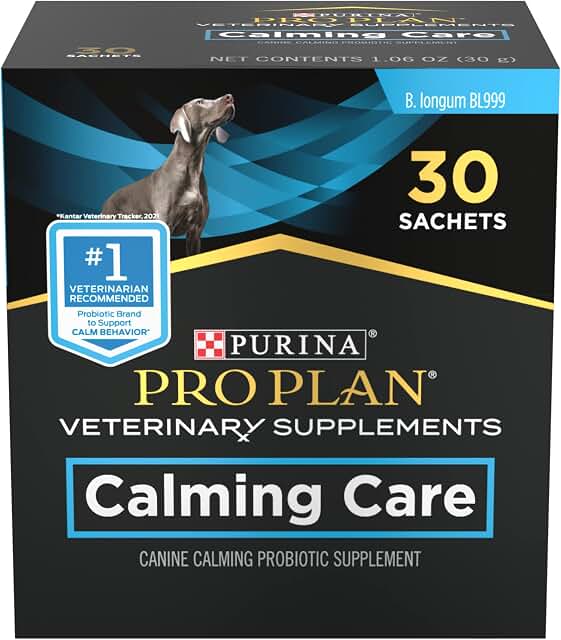
Purina Pro Plan Calming Care
Amazon
- Format:
- Chewable tablet (30 ct box)
- Use Case:
- Anxiety and stress-related behavioral support via gut-brain axis
- Vet Formulated:
- Yes
- Probiotic Strain:
- Bifidobacterium longum BL999
- Unique Mechanism:
- Gut-brain axis / calming behavior
What we like
- Only dog probiotic with Bifidobacterium longum BL999 – the specific strain studied for calming anxious behavior in dogs
- Addresses gut-brain axis – relevant for dogs with both GI issues and anxiety/stress triggers
- 4.3★ from 2,800 reviews – solid rating for a specialty behavioral supplement
- Recommended by vets for stress-related GI upset (travel, boarding, thunderstorms)
- Chewable tablet format easy to administer daily
Worth knowing
- Not a general digestive health probiotic – less useful for dogs without anxiety component
- Lower review count (2,800) compared to FortiFlora (47,600) – less real-world data
- Premium pricing at $33.99/30 ct, comparable to FortiFlora but for a more niche use case
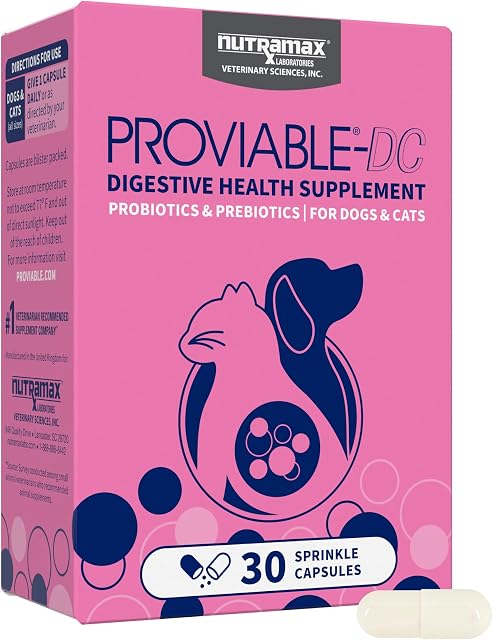
Nutramax Proviable Probiotics for Dogs and Cats (Capsules)
Amazon
- Format:
- Capsules (30 ct); can be opened and mixed into food
- Also For:
- Cats and dogs
- Use Case:
- Daily digestive health, broader microbiome support
- Probiotic Strains:
- Multi-strain (7+ strains including Lactobacillus and Bifidobacterium species)
- Includes Prebiotics:
- Yes
What we like
- Multi-strain formula with prebiotics – provides broader microbiome support than single-strain products like FortiFlora
- 18,300+ reviews at 4.6★ – second-largest review base in the dog probiotic category
- Capsules can be opened and mixed into food – versatile administration method confirmed by r/AskVet vets
- Affordable entry point at $19.97 for 30 capsules – best value among vet-recommended brands
- Consistently recommended by vets on Reddit as one of the two go-to clinical probiotics alongside FortiFlora
Worth knowing
- Capsule format less appealing for dogs who resist pill-taking and owners who don't mix into food
- Works for both dogs and cats – some owners prefer dog-specific formulations
- Lower CFU count vs. premium products – designed for maintenance rather than high-dose therapeutic use

Nutramax Proviable Chewable Tablets for Dogs
Amazon
- Format:
- Chewable tablets (60 ct)
- Also For:
- Dogs only (unlike capsule version)
- Use Case:
- Daily digestive health — dog-specific chewable format
- Probiotic Strains:
- Multi-strain (7+ strains)
- Includes Prebiotics:
- Yes
What we like
- Chewable tablet format makes the multi-strain Proviable formula easier to administer vs. capsules
- 60-count supply – better value for long-term daily use than 30 ct capsule version
- Same trusted multi-strain + prebiotic formula in a more palatable delivery
- 4.6★ rating consistent with capsule version – equally trusted by users
Worth knowing
- Higher price ($39.99 for 60 ct vs. $19.97 for 30 capsules – comparable per-dose cost but larger upfront spend)
- Fewer reviews (2,500) than capsule version – less established track record
- Not as versatile as capsules for dogs who need powder mixed into food

Zesty Paws Probiotics for Dogs
Amazon
- Count:
- 90 ct
- Format:
- Soft chews
- Use Case:
- Gut flora, digestive health, immune support
- Clinical Study:
- DE111 strain clinically studied
- Probiotic Strain:
- DE111 (Bacillus subtilis, clinically studied)
What we like
- 25,800+ reviews at 4.5★ – third-largest review base in the category, demonstrating broad consumer trust
- DE111 (Bacillus subtilis) is a clinically studied spore-forming strain with high stability – survives heat and stomach acid better than many Lactobacillus strains
- Soft chew format highly palatable – treat-like texture most dogs accept readily
- Broad support for gut flora, diarrhea relief, and immune health in one product
- Competitive price vs. FortiFlora for a larger supply
Worth knowing
- Not as consistently vet-recommended as FortiFlora or Proviable in clinical settings
- DE111 strain research base is smaller than Enterococcus faecium SF68 for acute diarrhea specifically
- Soft chew format may have palatability issues for dogs with food sensitivities to flavorings

The following products have strong consumer review counts but less clinical literature backing or less strain transparency than the options above. They are reasonable for daily maintenance use, but buyers should weigh the trade-off between convenience, price, and evidence depth.

PetLab Co. Probiotics for Dogs
Amazon
- Flavor:
- Salmon or Pork
- Format:
- Soft chews (30 ct)
- Target:
- General digestive + allergy support
- Use Case:
- Gut health, occasional diarrhea, digestive health, seasonal allergies

PetLab Co. Allergy & Immune Daily Probiotics for Dogs
Amazon
- Flavor:
- Pork
- Format:
- Soft chews (30 ct)
- Target:
- Allergy-prone dogs
- Use Case:
- Yeast balance, seasonal allergies, intermittent itchiness, gut health

Nutri-Vet Pre & Probiotics for Dogs (Soft Chews)
Amazon
- Flavor:
- Liver & Cheese
- Format:
- Soft chews (120 ct)
- Use Case:
- Digestive support, upset stomach, puppy probiotic
- Price Per Dose:
- $0.09/chew
- Includes Prebiotics:
- Yes

Fera Pets Probiotics for Dogs & Cats (USDA Organic Powder)
Amazon
- Format:
- Powder (60 scoops)
- Use Case:
- Immunity, energy, skin & coat, gut health
- Cfu Count:
- 5 billion CFUs
- Certification:
- USDA Organic
- Probiotic Strains:
- 12 strains
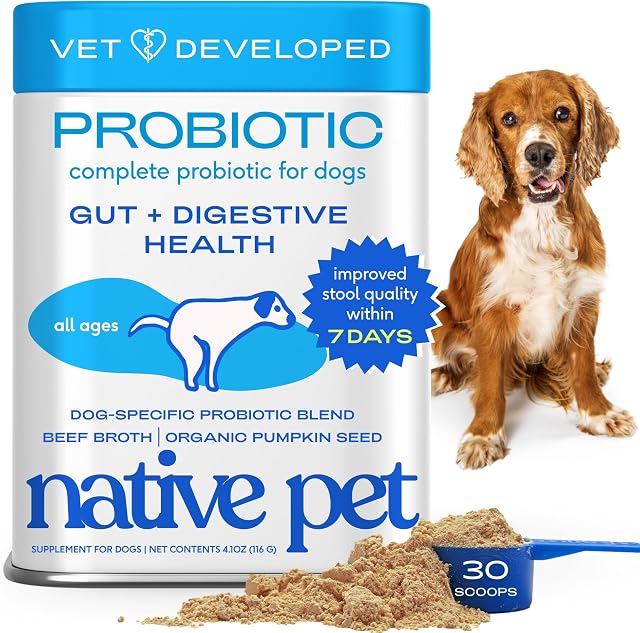
Native Pet Probiotics for Dogs (Powder)
Amazon
- Format:
- Powder (30 scoops)
- Use Case:
- Stool quality, diet transitions, gut & digestive health
- Cfu Count:
- 6 billion CFUs
- Vet Formulated:
- Yes
- Probiotic Strains:
- Dog-specific strains

Pet Honesty Probiotics for Dogs (Pumpkin)
Amazon
- Flavor:
- Pumpkin
- Format:
- Soft chews (90 ct)
- Use Case:
- Gut health, bowel support, regularity, immune support
- Added Ingredients:
- Pumpkin, digestive enzymes, fiber

Amazon Wag Probiotic Supplement Chews for Dogs
Amazon
- Flavor:
- Natural Duck
- Format:
- Soft chews (160 ct)
- Use Case:
- Digestive health, gut flora support
- Brand Type:
- Amazon house brand

Vet Advanced GI Care High Potency Probiotic
Amazon
- Format:
- Powder packets (30 ct)
- Storage:
- Refrigerated
- Cfu Count:
- 225 billion CFU
- Certification:
- Clean label certified
- Vet Recommended:
- Yes
- Probiotic Strains:
- 8-strain formula
Frequently Asked Questions
- What is the number one vet-recommended probiotic for dogs?
- Purina Pro Plan FortiFlora. PetMD's vet advisory panel names it their top-rated option, citing its clinically studied Enterococcus faecium SF68 strain, ease of dosing, and palatability. Nutramax Proviable is the second most consistently cited clinical recommendation, with vets in r/AskVet regularly listing both products as the two go-to options.
- What CFU count should a dog probiotic have?
- Preventive Vet recommends 1 to 10 billion CFU per day as a general baseline for healthy adult dogs, rising to 10 to 30 billion CFU during antibiotic treatment or active GI issues. That said, CFU count is a poor quality proxy on its own. FortiFlora contains only 100 million CFU per sachet and remains the most vet-recommended product in the category because strain quality and clinical backing matter more than raw quantity.
- Should dogs take probiotics every day?
- It depends on the dog. PetMD's vet panel notes that some dogs benefit from daily use for routine digestive maintenance, while others only need probiotics temporarily – during antibiotics, a diet transition, or a stressful event. A dog with chronic recurrent loose stool or seasonal skin flares is a better candidate for long-term daily use than a dog with occasional mild GI upset.
- Can probiotics help with dog anxiety?
- For anxiety-linked symptoms specifically, yes. Bifidobacterium longum BL999 – the strain in Purina Calming Care – has been studied for reducing anxious behaviors in dogs, including barking, jumping, spinning, and pacing. Cornell's veterinary college identifies anxiety support as one of the documented probiotic benefits. Standard digestive strains like Enterococcus faecium are not designed to address this pathway.
- Can probiotics help with dog allergies and paw licking?
- Probiotics can be a supportive layer for dogs with allergy-related symptoms and paw licking, but they are unlikely to resolve these issues on their own. Cornell's vet college lists allergy support among probiotic benefits. However, r/DogAdvice discussions on chronic paw licking consistently point to a multi-modal approach: allergy testing, Cytopoint or Apoquel, and ruling out skin infections, with probiotics as one part of that picture. If the paw licking is stress-driven, BL999 strains may be more relevant than digestive strains.
- Are human probiotics safe for dogs?
- Some strains are safe – Lactobacillus acidophilus appears in both human and dog products and is considered safe for dogs per Total.vet's assessment. The risk is not the organisms but the other ingredients. Human probiotic products frequently contain sweeteners including xylitol, which is toxic to dogs. The AKC recommends using dog-specific formulations for this reason.
- What is the difference between a probiotic and a prebiotic for dogs?
- Probiotics are live microorganisms that replenish the gut microbiome. Prebiotics are non-digestible food ingredients – such as fructooligosaccharides (FOS) – that act as fertilizer for beneficial bacteria already in the gut. Products combining both are called synbiotics. Several products marketed as 'probiotics' – including Nutramax Proviable and Nutri-Vet Pre & Probiotics – are technically synbiotics, per the Animal Medical Center of New York's definition.
- Can you give a dog probiotics while on antibiotics?
- Yes, but timing matters. Give the probiotic at least 2 hours after an oral antibiotic dose. Probiotics taken too close to antibiotics are rendered ineffective because the medication kills the live organisms. Continue probiotics throughout the full antibiotic course and for 1 to 2 weeks after the antibiotics are stopped to support microbiome recovery.
- Are there any side effects of giving dogs probiotics?
- Probiotics are generally well-tolerated. Temporary gas, bloating, or loose stool can occur when first starting, as the gut microbiome adjusts. YuMove advises against probiotics during active vomiting – stabilize the gut first. PetMD vets also flag that animal-based flavorings in some chews can trigger reactions in dogs with food sensitivities. An r/AskVet vet confirmed probiotics are safe alongside multiple concurrent medications when timed appropriately.
- Are probiotics safe for puppies?
- Yes, dog-specific probiotics can be used from any age, but dosing should be adjusted. Start puppies under 6 months at 1 to 2 billion CFU daily and increase gradually based on tolerance and veterinary input. Honest Paws notes that probiotic benefits for puppies include immune system development, improved nutrient absorption, and stress reduction during home transitions – particularly valuable during critical developmental windows.
Related articles