Enameled Dutch Oven Buying Guide
Researched by Forge
This article contains affiliate links. We may earn a commission at no extra cost to you. See our disclosure.

Why an Enameled Dutch Oven Lasts Decades While Ceramic Nonstick Fails in a Year
If you've ever burned through a ceramic nonstick pan and then wondered why your grandmother's Le Creuset still looks fine after 30 years, the answer isn't price or brand prestige. It's a completely different material. A top r/Cooking post on this exact question got a simple answer with 749 upvotes: 'You're confusing ceramic coating (sprayed on top) with enamel (baked on in a kiln).'
The short version: an enameled cast iron Dutch oven is coated in fused glass. Ceramic nonstick pans (like GreenPan) have a thin spray-on silicon coating. One is permanent unless you physically chip it. The other degrades with every use. Knowing the difference is the single most useful thing you can understand before buying either.
What 'Enameled' Actually Means: The Kiln-Fused Difference
Vitreous enamel is formulated glass. During manufacturing, enamel frit (powdered glass with added fluxes and colorants) is applied to a cast iron base and fired at temperatures between 800 and 1000°C. At that heat, the glass particles fuse into a permanent glassy layer that bonds to the metal at a molecular level. As Prudent Reviews explains, 'The enamel coating is made of fused glass particles that are melted down and sprayed onto the cookware's cast iron or steel surface.' Once that bond forms, it is chemically inert and essentially indestructible – unless you physically crack or chip it.
Ceramic nonstick coatings work on an entirely different principle. A thin spray-on silicon coating is applied to an aluminum base. That coating provides nonstick properties when new, but it wears away with use. Prudent Reviews notes that ceramic nonstick pans 'most pans will only last 1 to 3 years because the non-stick coating degrades with each use.' There's no kiln, no fusion, no permanent bond. It's a surface layer with a lifespan.
The practical implications are significant. Enameled cast iron is not nonstick – it requires oil for braising and searing – but it can handle acidic ingredients like tomato sauce and wine-based braising liquids without any issue. Bare cast iron reacts chemically with acidic foods, producing metallic flavors. The kiln-fused glass on an enameled Dutch oven acts as a complete barrier between the food and the iron beneath. Lodge's care guide confirms enameled cast iron is resistant to acidic and alkaline foods and requires no seasoning – ever. That's a direct consequence of what it's made of, not a marketing claim.
Why Budget Enameled Cookware Chips Faster
Not all enameled cast iron is equal. The kiln-fusing process matters, and so does enamel thickness. Budget brands use thinner enamel layers and may have lower quality control during firing – which produces a coating that looks identical when new but behaves very differently after two years of braising and bread baking. Bon Appétit's testing found Made In Dutch ovens had chipping reports within 1.5 months of purchase despite proper care. They also flagged Lodge for 'inconsistency in quality' across production runs. The enamel exists, it's glass-fused, but the thickness and uniformity of the bond determine how long it stays intact.
Once enamel chips, the problem accelerates. Prudent Reviews warns that 'once chipped, enamel cookware is likely to chip even more' because the exposed bare cast iron beneath can rust, and rust expands, undercutting the surrounding enamel further. A single chip on a cheap Dutch oven can turn into a spreading problem. On a Le Creuset or Staub – with thicker, more consistently fused enamel – chips from normal use are rare. The brands with documented multi-decade durability are the French-made options, and that's the primary reason Bon Appétit consistently names them as its top picks.
The other variable is heat distribution. Tramontina, for example, was specifically flagged by Bon Appétit for 'a persistent cold spot that resulted in uneven cooking and food sticking to the smooth interior enamel.' Uneven heating creates thermal stress during repeated heating and cooling cycles, which can contribute to enamel failure over time. A well-distributed heat cycle is kinder to the glass layer than a pot that runs hot in one spot and cold in another.

The Warranty Reality: Who Actually Replaces Chipped Enamel
Lifetime warranties are only meaningful if a company honors them. The data here is uneven. On r/BuyItForLife, one widely-upvoted post documents Lodge replacing a 20-year-old Dutch oven for free, then replacing the replacement when it also chipped, also for free. That's the kind of warranty that makes a lifetime claim credible. Bon Appétit confirmed that Zulay Kitchen has 'promptly replaced' every chipped enamel complaint found in customer reviews. On r/Cooking, users consistently report that 'Le Creuset will always repair and replace.'
By contrast, Amazon Basics offers only a 1-year warranty – which is why Bon Appétit dropped it as its budget pick in 2025 in favor of Zulay Kitchen, despite the Amazon Basics pot performing well in short-term testing. The gap between 1-year and lifetime coverage is the gap between a pot you may need to replace in two years and one you won't. If you're comparing budget options, warranty terms are the deciding factor that most reviews skip past.
Dutch Oven vs. Bread Cloche: Which Is Better for Sourdough?
If you bake sourdough regularly, you've probably wondered whether a dedicated bread cloche is worth the investment over a standard enameled Dutch oven. The answer depends on your priorities.
An enameled Dutch oven works perfectly well for sourdough. A standard 5 to 5.5-quart round pot holds a standard boule, and the sealed environment at 450°F for 30 minutes covered, then 20 minutes uncovered, produces excellent crust development. The bread quality is indistinguishable from a dedicated bread pan. A r/Sourdough commenter who owns both a Staub Dutch oven and cheaper bread bakers found 'zero difference in bread quality between the DO and the bread oven.' The advantage of the Dutch oven is versatility: you bake bread on Sunday and braise chicken on Tuesday. The disadvantage is loading dough into the narrow opening, which requires care with larger or more delicate loaves.
A dedicated bread cloche like the Challenger has a lower profile and wider opening, making loaf loading far easier. It's purpose-built for bread, with a sealed steam environment optimized for crust development. If bread baking is your primary use, the Challenger eliminates the awkward logistics of fitting dough into a Dutch oven's opening. The tradeoff is price (significantly higher at $299–$359) and single-purpose design – it cannot be used for braising, soups, or any other cooking.
For most home cooks, an enameled Dutch oven is the better choice. You get excellent bread quality plus the flexibility to use the pot for everyday cooking. If you bake 2 to 3 loaves weekly and find the Dutch oven opening frustrating, a dedicated bread cloche becomes worth the cost. For casual bakers, the Dutch oven is both more practical and more economical.
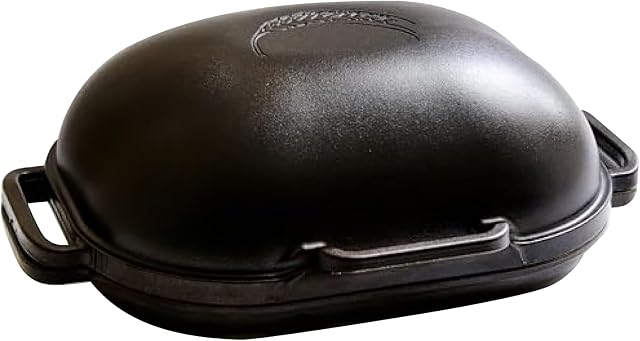
Challenger Bread Pan Cast Iron Loaf Pan
Amazon
- Type:
- Cast iron loaf pan with lid
- Design:
- Specialized for sourdough/bread baking
- Made In:
- USA
- Material:
- Pre-seasoned cast iron
- Lid Design:
- Sealed environment for steam retention
Recommended Enameled Dutch Ovens
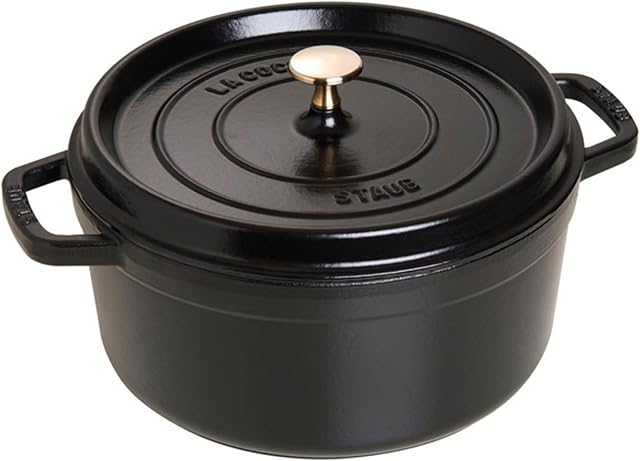
Staub 5.5-Quart Round Cocotte
Amazon
- Shape:
- Round
- Weight:
- 12.57 lbs
- Made In:
- France
- Capacity:
- 5.5 quarts
- Material:
- Enameled cast iron
- Warranty:
- Limited lifetime
- Heat Resistance:
- 500°F
- Interior Enamel:
- Dark and textured (black matte)
What we like
- Ranked best Dutch oven overall by Bon Appétit after testing 20+ models since 2018 – dark textured interior produces faster, more intense sear
- Self-basting lid design: only top-tested pot whose lid prevented scalding water from spattering at rolling boil (Bon Appétit)
- Dark interior enamel hides staining and discoloration – ages beautifully with use
- Made in France by Zwilling-owned brand; lifetime warranty with documented replacement support
- Reddit r/Cooking: 'Staub has an ingenious design on the lid, where it returns liquid to the pot, and they age beautifully'
Worth knowing
- More expensive than Lodge at $312–$430 – Reddit consensus says budget options perform identically for most cooks
- Heavier than Le Creuset at 12.57 lbs – can be unwieldy when full
- Dark interior makes it harder for beginners to monitor browning and fond development
- Lint from soft cotton dish towels can catch on the textured interior enamel (Bon Appétit noted this)

Le Creuset Signature Round Dutch Oven (5.5-Quart)
Amazon
- Shape:
- Round
- Weight:
- 11.6 lbs
- Made In:
- France
- Capacity:
- 5.5 quarts
- Material:
- Enameled cast iron
- Warranty:
- Limited lifetime
- Heat Resistance:
- 500°F
- Interior Enamel:
- Light and smooth (sand-colored)
What we like
- Heirloom-quality construction with chip-resistant enamel proven to last generations – Bon Appétit tested since 2018
- Light interior enamel makes it easy to monitor browning and fond development during searing
- Relatively lightweight at 11.6 lbs – about 1 lb lighter than the Staub 5.5-qt
- Company offers lifetime warranty with demonstrated willingness to replace – Reddit users on r/Cooking confirm 'Le Creuset will always repair and replace'
- Now standard with stainless steel knob rated for 500°F – safe for high-temp bread baking
Worth knowing
- Premium pricing ($350–$435) difficult to justify purely on cooking performance – Reddit r/Cooking consensus: 'A Lodge does exactly the same thing for $80'
- Light interior enamel shows discoloration and wear more readily than Staub's dark interior
- Lid allows scalding water to escape at rolling boil – Bon Appétit noted this as a specific failure vs. Staub
- Part of the price is brand prestige – Reddit users note 'a halo effect inflates perceived value beyond actual cooking performance'

Made In Round Dutch Oven (5.5-Quart)
Amazon
- Shape:
- Round
- Weight:
- 11.6 lbs
- Made In:
- France
- Capacity:
- 5.5 quarts
- Material:
- Enameled cast iron
- Warranty:
- Limited lifetime
- Heat Resistance:
- 500°F
- Interior Enamel:
- Light and smooth
What we like
- ~$100 less than comparable Le Creuset with near-identical quality – Bon Appétit found it 'on par with Le Creuset's version' in head-to-head testing
- Flat-surface handles with extra grip area make lifting a full pot easier than Le Creuset's loop handles
- Taller lid knob sits higher off the lid – easier to grab with oven mitts
- Crafted in France with lifetime warranty – genuinely heirloom-quality at a lower entry price
Worth knowing
- Only available in 3.5-qt and 5.5-qt sizes – very limited range vs. Le Creuset and Staub
- Limited color options – not suitable for building a matching cookware collection
- Fewer than 200 Amazon reviews vs. thousands for Le Creuset/Staub – less established long-term durability data
- Reddit reports of chipping issues on $1,000+ multi-piece orders within 1.5 months, with community skepticism about warranty response

Lodge Essential Enamel Cast Iron Dutch Oven (6-Quart)
Amazon
- Shape:
- Round
- Made In:
- USA
- Capacity:
- 6 quarts
- Material:
- Enameled cast iron
- Warranty:
- Lifetime
- Heat Resistance:
- 500°F
- Colors Available:
- Midnight Chrome, Caribbean Blue, Island Spice Red, Oyster White
What we like
- Most-reviewed Dutch oven on Amazon at 38,600 reviews and 4.7★ – broadest real-world validation in this category
- American-made with legendary warranty service – Reddit r/BuyItForLife documents Lodge replacing a 20-year-old Dutch oven for free, then replacing the chipped replacement also for free
- Fraction of premium brand pricing at ~$90 – Reddit r/Cooking top comment (325 upvotes): 'A Lodge Dutch oven does exactly the same thing and costs $80 instead of $400'
- Oven safe to 500°F and induction compatible – works on all stovetop types
- Moisture-sealing lid design keeps braises and stews well-hydrated
Worth knowing
- Enamel finish is less refined than Le Creuset or Staub – Bon Appétit notes inconsistent quality across Lodge lines with some chipping complaints
- Heavier than premium brands for equivalent capacity
- Bon Appétit does not recommend Lodge as a primary pick due to 'inconsistency in quality' between production runs
- Less prestigious for gifting or display – lacks the cachet of French-made brands

Zulay Kitchen 6-Quart Dutch Oven
Amazon
- Shape:
- Round
- Weight:
- 14.34 lbs
- Capacity:
- 6 quarts
- Material:
- Enameled cast iron
- Warranty:
- Lifetime
- Available Sizes:
- 6-qt only
- Heat Resistance:
- 500°F
- Interior Enamel:
- Light and smooth
What we like
- Best budget Dutch oven pick by Bon Appétit – replaced Amazon Basics as their budget recommendation in 2025
- Lifetime warranty with documented replacement history – Bon Appétit confirmed every chipped enamel review mentioned prompt replacement
- Thick cast iron heats evenly with no cold spots found in Bon Appétit testing – outperformed Tramontina and Cuisinart
- Dishwasher-safe enamel (though hand-washing recommended) – indicates durable enamel coating
- Looks nearly identical to Le Creuset at a fraction of the price
Worth knowing
- Only available in 6-quart size – no smaller or larger options
- Heaviest tested Dutch oven at 14.34 lbs due to thick cast iron walls
- Cooking surface is slightly convex – oil pools toward edges when sautéing (Bon Appétit noted this)
- Newer/less established brand than Lodge – limited multi-year durability data

Tramontina Bestow Enameled Cast Iron Dutch Oven (5.5-Quart Round)
Amazon
- Shape:
- Round
- Origin:
- Brazil
- Capacity:
- 5.5 quarts
- Material:
- Enameled cast iron
- Heat Resistance:
- Not specified
- Interior Enamel:
- Matte white
What we like
- Budget-friendly at $60 with Amazon Choice designation
- 4.6★ from 3,600 reviews – solid real-world user validation
- Round shape works well for sourdough bread baking and general braising
Worth knowing
- Bon Appétit explicitly does not recommend Tramontina – found 'a persistent cold spot that resulted in uneven cooking and food sticking to the smooth interior enamel' in testing
- Thinner cast iron than Lodge or premium brands – less heat retention
- Limited warranty information compared to competitors

Overmont Enameled Cast Iron Dutch Oven (5.5-Quart)
Amazon
- Shape:
- Round
- Colors:
- Cream White, Bottle Green
- Capacity:
- 5.5 quarts
- Includes:
- Cookbook and cotton potholders
- Material:
- Enameled cast iron
- Heat Resistance:
- 500°F
What we like
- Budget entry point at under $50 with 9,000+ reviews at 4.7★
- Includes cookbook and cotton potholders – complete starter kit
- Oven safe to 500°F – supports bread baking at high temperatures
- Multiple color options including bottle green and cream white
Worth knowing
- Newer brand with uncertain long-term enamel durability
- No independent professional testing data available
- Warranty terms not prominently disclosed

Caraway Enameled Cast Iron Dutch Oven (6.5-Quart)
Amazon
- Shape:
- Round
- Capacity:
- 6.5 quarts
- Material:
- Enameled cast iron
- Available Sizes:
- 6.5-qt only
- Heat Resistance:
- 500°F
- Interior Enamel:
- Dark and textured (like Staub)
What we like
- Dark textured interior enamel like Staub – great for browning and sautéing
- Available individually or as part of a full matching cookware set
- Colorful DTC brand with strong aesthetic – popular with design-conscious cooks
- Tested and liked by Bon Appétit: 'there's a lot to love about this Dutch oven'
Worth knowing
- Only available in 6.5-quart size – larger than ideal for most home cooks
- Shallow, awkward side handles – Bon Appétit specifically called these out as a design flaw
- Not recommended as a primary pick by Bon Appétit due to size and handle issues
- Low review count (105) relative to price point

Martha Stewart Gatwick 7-Quart Enamel Cast Iron Dutch Oven
Amazon
- Color:
- Linen with silver knob
- Shape:
- Round
- Capacity:
- 7 quarts
- Material:
- Enameled cast iron
- Use Cases:
- Slow cooking and braising
What we like
- Large 7-quart capacity at a budget price of $63 – excellent value for large families or batch cooking
- 4.6★ from 2,000 reviews – strong real-world validation
- Recognizable brand name adds gifting appeal at a fraction of premium brand pricing
Worth knowing
- No independent professional testing data from major publications
- 7-quart size may be too large for everyday home cooking for 2–4 people
- Warranty terms not prominently disclosed compared to Zulay or Lodge
Also Worth Considering
Amazon Basics Enameled Cast Iron Dutch Oven (6-Quart)
Amazon
- Shape:
- Round
- Capacity:
- 4.3–7.3 quarts (multiple sizes)
- Material:
- Enameled cast iron
- Warranty:
- 1 year
- Heat Resistance:
- 500°F
- Interior Enamel:
- Light and smooth
- Available Colors:
- 10 colors
What we like
- 51,400+ Amazon reviews at 4.7★ – most reviewed budget Dutch oven available
- Heated evenly and produced even sear in Bon Appétit testing – 'surprisingly good for such an accessible price tag'
- Available in 3 sizes and 10 colors – most variety of any budget option
- Lid retains moisture well at low simmering temps – ideal for braising
Worth knowing
- Only 1-year warranty vs. lifetime warranties on Zulay and premium brands
- Replaced as Bon Appétit budget pick in 2025 by Zulay Kitchen due to shorter warranty
- Long-term enamel durability less proven than Lodge or premium French brands
The Amazon Basics Enameled Cast Iron Dutch Oven performed well in short-term Bon Appétit testing and has over 51,400 reviews at 4.7 stars, but its 1-year warranty puts it at a structural disadvantage next to lifetime-warranty alternatives at similar prices.

Lodge 4.5-Quart Enameled Cast Iron Dutch Oven
Amazon
- Color:
- Caribbean Blue
- Shape:
- Round
- Made In:
- USA
- Capacity:
- 4.5 quarts
- Material:
- Enameled cast iron
- Heat Resistance:
- 500°F
What we like
- Ideal size for 2–3 person households – fits most standard recipes without excess
- American-made with Lodge's legendary warranty service at a lower price than the 6-qt
- 4.7★ from 3,100 reviews – strong real-world validation for this size
- Lower price than the 6-qt model at $69.90
Worth knowing
- Smaller capacity limits batch cooking or entertaining
- Same inconsistent quality concerns across Lodge's Essential Enamel line noted by Bon Appétit
- Not as widely reviewed or documented as Lodge's flagship 6-qt model
The Lodge 4.5-Quart Enameled Cast Iron Dutch Oven is the right call for 2-3 person households who don't need the full 6-quart capacity – same Lodge warranty, lower price, and easier to lift when full.
Frequently Asked Questions
- Is enameled cast iron the same as ceramic nonstick?
- No. Despite both being called 'ceramic' in marketing, they are fundamentally different materials. Enameled cast iron is coated in kiln-fused glass that bonds permanently to the metal. Ceramic nonstick (like GreenPan) uses a spray-on silicon coating that degrades with use. As one r/Cooking comment with 749 upvotes put it: 'Enameled cast iron is cooking on a rock – ceramic nonstick is still just a nonstick pan.' The enameled Dutch oven is not nonstick and requires oil, but it can last decades. Ceramic nonstick typically lasts 1 to 3 years before the coating fails.
- Is Le Creuset actually worth the price, or is a Lodge just as good?
- For actual cooking performance, Lodge performs identically. The top comment on r/Cooking's 'Is Le Creuset worth it?' thread has 325 upvotes: 'A Lodge Dutch oven does exactly the same thing and costs $80 instead of $400.' The real difference is enamel durability over decades, warranty follow-through, and lid performance. Bon Appétit's professional testing found Le Creuset and Staub are the only options with documented multi-decade durability. Buy Lodge if you want strong performance at low cost. Buy Le Creuset secondhand or on sale if you want a pot you genuinely won't replace.
- Why does the enamel chip on budget Dutch ovens faster?
- Thinner enamel layers and less consistent quality control during firing mean the glass-to-metal bond is weaker. Bon Appétit found Made In Dutch ovens had chipping reports within 1.5 months of purchase, and flagged Lodge for inconsistency across production runs. Once enamel chips, bare cast iron beneath can rust, which accelerates further chipping. Premium brands like Le Creuset and Staub use thicker enamel with more consistent fusing, which is why they have documented 20-plus-year lifespans.
- Which brands actually honor their lifetime warranties when enamel chips?
- Lodge, Le Creuset, Staub, and Zulay Kitchen all have documented replacement histories. On r/BuyItForLife, Lodge replaced a 20-year-old Dutch oven for free, then replaced the chipped replacement also for free. Bon Appétit confirmed Zulay Kitchen promptly replaced every chipped enamel complaint found in customer reviews. R/Cooking users consistently confirm Le Creuset replaces as well. Amazon Basics offers only a 1-year warranty, which is why Bon Appétit dropped it as its budget pick in 2025.
- What's the difference between a Dutch oven and a braiser?
- A braiser is a shallower, wider vessel designed for cooking food at a lower level where you can monitor browning more easily. A Dutch oven is taller and narrower, optimized for stacking foods and holding liquids for stewing and braising. Both are enameled cast iron and function similarly for braising, but a Dutch oven's vertical shape makes it better for whole-bird roasting and bread baking. For general braising of meats and vegetables, a braiser is more practical because you need less liquid and have better visibility. For versatility across soups, stews, and bread baking, a Dutch oven is the better choice.
- What can you cook in a Dutch oven?
- A Dutch oven is one of the most versatile vessels in the kitchen. You can braise short ribs, roast whole chickens, bake sourdough bread, simmer stews and soups for hours, sear beef and finish in the oven, make risotto, cook chili, bake casseroles, and even make desserts like cobblers. The enameled surface handles acidic ingredients like tomato sauce and wine without any chemical reaction. You can go from stovetop to oven at temperatures up to 500°F. The sealed lid retains moisture, making it ideal for slow cooking. The only limitation is cooking liquid-forward dishes that require frequent stirring, since the narrow opening makes it less convenient than an open pot for constant monitoring.
- Can I use an enameled Dutch oven for sourdough bread baking?
- Yes. A round 5 to 5.5-quart Dutch oven is the standard vessel for home sourdough baking. The common method is 450°F for 30 minutes covered, then 20 minutes uncovered. The main requirement is a knob rated for high heat – older Le Creuset models with plastic phenolic knobs would melt at bread-baking temperatures. Current Le Creuset Signature models come with a stainless steel knob rated to 500°F. A r/Sourdough commenter who compared a Staub Dutch oven and a cheap bread baker side-by-side found zero measurable difference in bread quality.
- What size Dutch oven should I buy?
- For most home cooks, 5 to 5.5 quarts is the right starting point. Le Creuset's official sizing guide recommends a minimum of 4 quarts for a family of four, with 5 to 5.5 quarts as the ideal all-purpose size. Lodge's guide aligns: 5 to 6 quarts for four people, 7 to 7.5 quarts for larger families. For sourdough baking specifically, Pantry Mama recommends a round 5 to 5.5-quart Dutch oven for a standard boule. The 5.5-quart round is the flagship size for Le Creuset, Staub, and Made In for good reason – it's the right size for most recipes.
- How do I clean an enameled cast iron Dutch oven?
- Hand wash with warm soapy water after each use. For stuck-on food, The Kitchn found that boiling water with baking soda (4 cups water plus 2 tablespoons baking soda) removes burnt-on residue in 10 to 15 minutes with minimal scrubbing. Avoid citrus-based cleaners, which dull the exterior gloss. Use wooden, silicone, or nylon utensils only – metal scratches enamel. Never preheat an empty Dutch oven on the stovetop, and avoid thermal shock (like adding ice to a hot pot). Dry thoroughly before storing to prevent rim rust. No seasoning is ever needed.
- What is the difference between Le Creuset and Staub?
- Both are French-made, enameled cast iron Dutch ovens at similar price points, but they differ in interior enamel. Le Creuset has a light, smooth sand-colored interior that makes it easier to monitor browning and fond development – but it shows discoloration over time and allows water to escape at a rolling boil. Staub has a dark, textured black matte interior that produces faster browning, hides staining, and the lid design prevents water from spattering even at a rolling boil (Bon Appétit confirmed this in testing). Le Creuset is about 1 pound lighter at 11.6 lbs versus Staub's 12.57 lbs. Bon Appétit named Staub its overall winner in 2025; Reddit sees them as essentially equivalent.
- Should I buy a round or oval Dutch oven?
- Round for most home cooks. Round Dutch ovens fit standard burner shapes including induction, are ideal for sourdough boules, and are the format recommended by Bon Appétit, Serious Eats, and Lodge for general use. Oval fits whole chickens and larger cuts of meat better, but Bon Appétit noted that large oval shapes don't work well with round induction burners. A 5.5-quart round is the consensus first Dutch oven recommendation. If you regularly bake batard-shaped sourdough loaves, an oval would be preferable – but for everything else, round is the practical choice.
- Is it worth buying a Dutch oven secondhand?
- Yes, absolutely. A kiln-fused enamel coating doesn't degrade with age, only with physical damage. A 20-year-old Le Creuset or Staub in good condition with intact enamel will perform identically to a new one. Secondhand premium pots beat new budget pots on every longevity metric. Check marketplace listings or a Le Creuset outlet store for good deals. Inspect the interior and exterior for chips or cracks in the enamel before buying. A secondhand premium Dutch oven beats a new budget option on durability, because you're buying enamel that's already been proven over years of actual use.
Related articles