- Product
- Lifepro BioHeal Plus
- Form Factor
- Hanging panel
- Irradiance
- 212 mW/cm² at 3 in
- Wavelengths
- 660nm, 850nm
- FDA Cleared
- Yes
- Best For
- Panel value pick
Best Red Light Therapy Device for Every Budget
Researched by Verity
·19 min read
This article contains affiliate links. We may earn a commission at no extra cost to you. See our disclosure.


Quick Picks
- Form Factor
- Hard shell mask
- Irradiance
- 60 mW/cm²
- Wavelengths
- 415nm, 605nm, 630nm, 880nm
- FDA Cleared
- Yes
- Best For
- Short daily sessions
- Product
- Therabody TheraFace Mask
- Form Factor
- Hard shell mask
- Irradiance
- 73 mW/cm²
- Wavelengths
- Blue, red, NIR (nm undisclosed)
- FDA Cleared
- Yes
- Best For
- Highest mask irradiance
- Product
- Therabody TheraFace Mask Glo
- Form Factor
- Cordless mask
- Irradiance
- Not published
- Wavelengths
- Red, blue, NIR
- FDA Cleared
- Yes
- Best For
- Budget Therabody option
- Form Factor
- Wearable mask
- Irradiance
- Not published
- Wavelengths
- 635nm, 830nm, 415nm
- FDA Cleared
- Yes
- Best For
- Multi-mode acne + anti-aging
- Product
- Solawave 4-in-1 Wand
- Form Factor
- Handheld wand
- Irradiance
- 49.5–60.5 mW/cm²
- Wavelengths
- 630nm
- FDA Cleared
- Yes
- Best For
- Spot treatment entry point
- Product
- Hooga HG300
- Form Factor
- Desktop panel
- Irradiance
- Not independently published
- Wavelengths
- 660nm, 850nm
- FDA Cleared
- Not confirmed
- Best For
- Budget panel with proven community reputation
- Product
- Hooga PRO300
- Form Factor
- Desktop panel
- Irradiance
- Published by brand
- Wavelengths
- 660nm, 850nm
- FDA Cleared
- Not confirmed
- Best For
- Mid-range dual-chip step-up
- Product
- Hooga ULTRA360
- Form Factor
- Desktop panel
- Irradiance
- Not independently published
- Wavelengths
- 630nm, 660nm, 810nm, 850nm
- FDA Cleared
- Not confirmed
- Best For
- Broadest Hooga spectral coverage
- Product
- MitoMIN 2.0
- Form Factor
- Compact desktop panel
- Irradiance
- Lab-tested (published)
- Wavelengths
- 660nm, 850nm
- FDA Cleared
- Not confirmed
- Best For
- Data-transparent brand for skeptics
- Product
- BestQool 170W 4-Wavelength
- Form Factor
- Desktop/wall panel
- Irradiance
- Not independently published
- Wavelengths
- 630nm, 660nm, 810nm, 850nm
- FDA Cleared
- Not confirmed
- Best For
- Four-wavelength coverage under $280
Red Light Therapy Panel Reviews
Lifepro BioHeal Plus Red Light Panel
Lifepro BioHeal Plus Red Light Panel
Amazon / Lifepro
4.6(789 reviews)
- Leds:
- 90–120 dual-chip LEDs
- Warranty:
- Lifetime (registration required within 14 days)
- Irradiance:
- 212 mW/cm² at 3 inches; 140 mW/cm² at 6 inches
- Form Factor:
- Hanging panel (no built-in stand)
- Wavelengths:
- 660nm (red), 850nm (near-infrared)
- Return Policy:
- 30 days via Amazon
The Lifepro BioHeal Plus is the rare consumer panel where the irradiance numbers are actually published and independently tested. Fortune's testing measured 212 mW/cm² at 3 inches and 140 mW/cm² at 6 inches – a 34% reduction that makes the point about distance more clearly than any chart. That 212 mW/cm² figure puts it into territory that Fortune described as 'firmly into pro-grade,' and the 4.6-star rating across 789 Amazon reviews suggests buyers are not being misled.
The trade-off is setup: this panel hangs rather than stands, and Fortune's tester found the pulley system 'complicated' enough that most buyers end up leaning it against a wall instead. The lifetime warranty is the strongest protection available in this category, but it requires registration within 14 days of receipt – easy to forget. Coverage is dual-spectrum 660nm and 850nm only, which is sufficient for most skin and inflammation use cases but skips the four-wavelength configurations found on the BestQool and Hooga ULTRA360.
What we like
- 212 mW/cm² at 3 inches – highest irradiance of any consumer panel under $500 tested by Fortune; 'firmly into pro-grade territory'
- Lifetime warranty (with 14-day registration) – strongest consumer protection in this category
- ~$330 on Amazon; Fortune tester rated value 4/5 and noted it 'overdelivers for its price bracket'
- 4.6 stars with 789 Amazon reviews confirming strong user satisfaction at the price
Worth knowing
- No built-in stand – hanging-only with pulley system Fortune tester described as 'complicated'; most buyers lean it against the wall
- Limited to 660nm + 850nm dual-wavelength spectrum; no four-wavelength coverage
- Lifetime warranty requires registration within 14 days of receipt – easy to miss
Hooga HG300 Red Light Therapy Panel
Hooga HG300 Red Light Therapy Panel
Amazon
4.6(1,000 reviews)
- Leds:
- 60
- Timer:
- Built-in
- Price Tier:
- Entry-level panel
- Form Factor:
- Desktop panel with adjustable stand and carrying handle
- Wavelengths:
- 660nm (red), 850nm (near-infrared)
The Hooga HG300 is the entry point into the Hooga ecosystem, which has earned a consistently positive reputation across r/redlighttherapy and r/Biohackers. With 4.6 stars across 1,000+ Amazon reviews, it is the most reviewed panel in its price tier. Users report real results for skin, joint pain, period cramps, and migraines – a range that suggests the 660nm and 850nm dual-chip coverage is doing something beyond placebo. One r/redlighttherapy user with endometriosis reported pain relief on first use, while another attributed reduced migraine frequency to neck-area sessions.
What the HG300 lacks is independently verified irradiance data. The brand does not prominently publish third-party tested mW/cm² figures, which makes precise dosing calculations impossible – a real limitation for buyers who want to know whether they're hitting therapeutic thresholds rather than just feeling warm light on their skin. The 60 LEDs also constrain treatment area coverage; this is a face-and-neck device, not a meaningful full-body option. If the community trust and price make it attractive, it's a reasonable starting point, but know what you're buying into.
What we like
- 4.6 stars with 1,000+ Amazon reviews – most reviewed panel in this price range; strong consumer satisfaction
- Includes adjustable stand and carrying handle for practical repositioning between sessions
- 660nm + 850nm dual-chip design covers both surface skin benefits and deeper tissue repair
- Reddit users specifically call Hooga 'legit' with reports of real results for skin, joint pain, period cramps, and migraines
Worth knowing
- 60 LEDs provides modest coverage – limited to face and small body areas; not suitable for full-body treatment
- Brand does not prominently publish independently third-party verified irradiance data vs. premium brands
- Requires consistent routine adherence – Reddit confirms irregular use produces no visible skin results
Hooga PRO300 Red Light Therapy Panel
Hooga PRO300 Red Light Therapy Panel
Amazon
4.6(700 reviews)
- Leds:
- 60 dual-chip LEDs
- Timer:
- Built-in
- Chip Type:
- Dual-chip (two diodes per LED housing)
- Price Tier:
- Mid-range panel
- Form Factor:
- Desktop panel with adjustable stand
- Wavelengths:
- 660nm (red), 850nm (near-infrared)
The Hooga PRO300 takes the same LED count as the HG300 but swaps in dual-chip LEDs – meaning each LED housing contains two diodes, increasing photon density without increasing the panel's footprint. The PRO also publishes irradiance specifications, which matters: it means you can calculate session duration and distance instead of guessing. Across r/redlighttherapy, PRO-series users report reduced morning stiffness from knee osteoarthritis at weeks 3-4 and skin texture improvement at weeks 6-7 – timelines consistent with what the research suggests for consistent use.
The PRO300 sits in the middle of the Hooga lineup – a meaningful upgrade over the HG300 for data-conscious buyers who want to dose more precisely, but limited to the 660nm and 850nm dual spectrum. If you know you want four-wavelength coverage for both surface skin benefits and deeper tissue work, the ULTRA360 is the next step. For most people managing joint discomfort or starting a skin-focused routine, the PRO300 is the practical choice within the Hooga range.
What we like
- Dual-chip LEDs deliver higher photon density than single-chip HG300 at same LED count
- 4.6 stars with 700+ Amazon reviews – strong real-world satisfaction across an established review base
- Publishes irradiance specifications – important for calculating therapeutic dosing vs. generic alternatives
- Reddit Hooga PRO users report reduced morning stiffness from knee OA at week 3-4 and skin texture improvement at week 6-7
Worth knowing
- Limited coverage as a single panel – full-body treatment requires multiple panels or extended sessions
- No four-wavelength coverage; limited to 660/850nm dual spectrum vs. ULTRA360

Hooga ULTRA360 Red Light Therapy Panel

Hooga ULTRA360 Red Light Therapy Panel
Amazon
4.6(167 reviews)
- Leds:
- 72 quad-chip LEDs
- Features:
- Adjustable brightness, pulse mode
- Price Tier:
- Mid-to-upper panel
- Form Factor:
- Desktop panel with adjustable stand
- Wavelengths:
- 630nm, 660nm, 810nm, 850nm
The Hooga ULTRA360 is the top of the Hooga lineup for home users who want spectral flexibility. The quad-chip LED design delivers four wavelengths – 630nm, 660nm, 810nm, and 850nm – in a single panel, which means the 630-660nm range associated with surface collagen stimulation and the 810-850nm range associated with deeper tissue inflammation reduction are both covered. Adjustable brightness and a pulse mode allow some customization of protocols, which is uncommon at this price tier.
The caveat is limited review history: 167 Amazon reviews versus 700-1,000 for the HG300 and PRO300 means there's less long-term reliability data to draw confidence from. At around $399, it also starts competing with panels from dedicated precision brands. The general positive Hooga brand sentiment in the Reddit community applies, but no specific ULTRA360 mentions appeared in the research – buyers are largely extending trust from the broader lineup rather than model-specific reports.
What we like
- Quad-chip LEDs with four wavelengths (630/660/810/850nm) – broadest spectral coverage in the Hooga lineup
- Adjustable brightness and pulse mode enables customization for skin vs. deeper tissue protocols
- 72 quad-chip LEDs deliver higher total photon output than Hooga's single or dual-chip entry panels
Worth knowing
- Only 167 Amazon reviews vs. 700-1000 for HG300/PRO300 – less long-term reliability data
- At $399, approaches premium panel territory where other specialty brands offer comparable or better specs
MitoMIN 2.0 Red Light Panel

MitoMIN 2.0 Red Light Panel
Amazon / Mito Red Light
4.5(121 reviews)
- Price Tier:
- Entry-level Mito panel
- Form Factor:
- Compact desktop panel for face and neck
- Wavelengths:
- 660nm (red), 850nm (near-infrared)
- Brand Positioning:
- USA-engineered, lab-tested irradiance
Mito Red Light has carved out a specific reputation in the biohacking community for one reason: they publish independently lab-tested irradiance data. That transparency is rarer than it should be. A r/Biohackers commenter cited using Mito Red Light and trusting it 'because I know their actual test data,' noting that knowing the exact output made sessions feel purposeful rather than guesswork. The MitoMIN 2.0 is the compact entry point into that ecosystem, covering 660nm red and 850nm near-infrared with a 4.5-star Amazon rating.
The limitations are practical: only 121 Amazon reviews provide a thin long-term reliability record compared to Hooga, and the compact form factor makes it primarily a face and neck panel rather than anything approaching full-body coverage. If irradiance transparency is the deciding factor and the BioHeal Plus's hanging setup doesn't suit your space, the MitoMIN 2.0 is worth serious consideration for smaller treatment area needs.
What we like
- Mito Red Light is respected in the biohacking community for publishing actual independently tested irradiance data – one of the few brands to do so
- 4.5-star Amazon rating with legitimate review base
- USA-engineered positioning with documented specifications distinguishes it from generic white-label Chinese competitors
Worth knowing
- Only 121 Amazon reviews – limited public track record compared to Hooga
- Compact size limits coverage; primarily a face/neck device despite panel format
- Direct website pricing may be more competitive than Amazon listings
BestQool Red Light Therapy Panel (170W, 4-Wavelength)

BestQool Red Light Therapy Panel (170W, 4-wavelength)
Amazon
4.7(451 reviews)
- Leds:
- 100 dual-chip elite grade LEDs
- Power:
- 170W
- Form Factor:
- Desktop/wall panel with modular design
- Wavelengths:
- 630nm, 660nm, 810nm, 850nm
The BestQool 170W panel offers the broadest spectral coverage available under $280: four wavelengths (630nm, 660nm, 810nm, 850nm) via 100 dual-chip elite-grade LEDs at 170W total power. Its 4.7-star average across 451 Amazon reviews is the highest of any panel tested at this price point. The modular design – panels can be connected together – also gives buyers a path to expanded treatment area coverage without replacing their hardware.
The gaps are transparency and community reputation. BestQool does not prominently publish third-party independent irradiance verification, which means you cannot confirm therapeutic dosing the way you can with Lifepro or Mito Red Light. The brand is also less discussed in enthusiast communities compared to Hooga or Mito, which means less accumulated real-world feedback. For buyers prioritizing spectral range over verified irradiance data, the BestQool is a compelling value; buyers prioritizing measurement transparency should look at Lifepro or MitoMIN first.
What we like
- Four-wavelength coverage (630/660/810/850nm) at under $280 – better spectral range than most competing panels at this price
- 4.7 stars with 451 Amazon reviews – highest rating of any panel at this price bracket
- Modular design allows connection with other BestQool panels for expandable full-body coverage
- 170W with dual-chip LEDs delivers higher photon density per LED than single-chip designs
Worth knowing
- Less brand recognition in enthusiast communities vs. Hooga or Mito Red Light
- Third-party independent irradiance verification not prominently published
- Modular expansion adds cost if full-body coverage is the goal
Red Light Therapy Face Mask Reviews
Dr. Dennis Gross DRx SpectraLite FaceWare Pro

Dr. Dennis Gross DRx SpectraLite FaceWare Pro
Amazon / Sephora / Dermstore
3.7(584 reviews)
- Leds:
- 160 (100 red, 60 blue)
- Warranty:
- 1 year
- Irradiance:
- 60 mW/cm²
- Fda Cleared:
- Yes
- Form Factor:
- Hard shell cordless mask
- Wavelengths:
- 415nm (blue), 605nm (amber), 630nm (red), 880nm (near-infrared)
- Treatment Time:
- 3 minutes (auto shutoff)
WIRED named it 'Best for Short Treatment Sessions' – and that framing is accurate but also a little damning. The Dr. Dennis Gross FaceWare Pro earns its place because 60 mW/cm² irradiance paired with a 3-minute auto-shutoff session means you get meaningful light dose delivered without the commitment of longer protocols. WIRED's tester used it near-daily for 6 weeks without charging, and the blue light acne mode produced noticeable blemish reduction within 2 weeks of targeted testing. At 160 LEDs covering four wavelengths (415nm, 605nm, 630nm, 880nm), the spectral breadth is real.
The reliability picture is harder to ignore. An Amazon rating of 3.7 stars across 584 reviews – combined with multiple reports of charging failures and connectivity issues – is a meaningful signal for a mask priced at $455 with only a 1-year warranty. The hard shell design also creates a coverage gap: no treatment to the nasolabial folds or around the nose and mouth, which flexible masks address. Two separate WIRED reviewers independently noted the silicone strap loosens mid-session. The convenience case is strong; the durability case is not.
What we like
- 3-minute sessions with auto shutoff – shortest treatment time of any tested mask; easiest to incorporate into a daily routine
- Exceptional battery life – WIRED tester used it near-daily for 6 weeks without charging
- 60 mW/cm² irradiance compensates for shorter sessions; high dose delivery in minimal time
- Blue light acne mode noticeably reduced blemishes during WIRED 2-week targeted test
Worth knowing
- Only 1-year warranty – shortest of premium masks at $455; concerning relative to price
- Amazon rating is 3.7 stars across 584 reviews – multiple reports of charging failures and connectivity issues
- Hard shell with no nose/mouth coverage misses nasolabial fold area that flexible masks treat
- Silicone strap consistently loosens mid-treatment – confirmed independently by two separate WIRED reviewers
Therabody TheraFace Mask (Original)

Therabody TheraFace Mask (original)
Amazon / Therabody
3.8(82 reviews)
- Irradiance:
- 73 mW/cm²
- Fda Cleared:
- Yes
- Form Factor:
- Hard shell cordless mask with padded Y-strap
- Wavelengths:
- Blue, red, near-infrared (exact nm undisclosed by brand)
- Special Features:
- Vibration therapy at temples and eye area
The Therabody TheraFace Mask posts the highest irradiance of any tested face mask at 73 mW/cm², matching the Shark CryoGlow in that critical metric. Full-face coverage including lips and nasolabial folds is a genuine structural advantage over hard-shell masks with central cutouts. The padded single Y-strap and supple eye shields were flagged as notable comfort improvements by Wirecutter reviewers.
The core problem is price-to-performance ratio. At $649 versus the Shark CryoGlow at $349 for identical irradiance, Therabody is charging a $300 premium for vibration therapy that Wirecutter described as 'noisy and superfluous' – a feature that doesn't improve LED outcomes. The brand also does not publish exact wavelength nanometers, which is an unusual lack of transparency for the most expensive mask in the category. With only 82 Amazon reviews, long-term reliability assessment remains limited.
What we like
- 73 mW/cm² irradiance – matching the Shark CryoGlow (highest of all tested face masks)
- Full-face coverage including lips and nasolabial folds – no holes limit LED access to aging-prone zones
- Padded single Y-strap and supple eye shields noted as premium comfort features
Worth knowing
- $649 vs. Shark CryoGlow at $349 for identical irradiance – premium is not justified by performance data
- Vibration therapy divided testers – 'noisy and superfluous' per Wirecutter; doesn't improve LED outcomes
- 3.8 Amazon rating across only 82 reviews suggests satisfaction or reliability concerns
- Brand does not publish exact wavelength nanometers – unusual lack of transparency for a $649 device
Therabody TheraFace Mask Glo
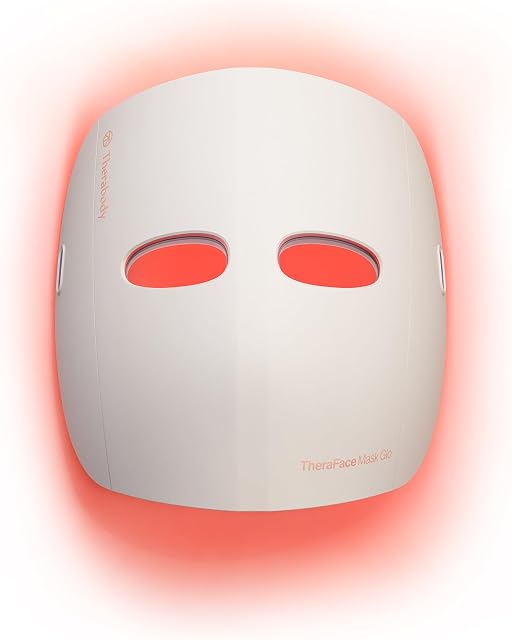
Therabody TheraFace Mask Glo
Amazon / Therabody
4.2(155 reviews)
- Fda Cleared:
- Yes
- Form Factor:
- Cordless LED mask with head-strap scalp massage
- Wavelengths:
- Red, blue, near-infrared
- Special Features:
- Scalp massage via repositioned head straps
The TheraFace Mask Glo launched as the more accessible version of the original TheraFace, dropping from $650 to $380 while retaining red, blue, and near-infrared light modes with FDA clearance. WIRED gave it an honorable mention, which is the appropriate grade: it's a meaningful price step-down from the original while delivering the same core wavelength coverage in a cordless format.
The vibration massage that divided opinion on the original has been relocated from the mask face to the head straps, and WIRED's tester found this iteration caused headaches – a notable downgrade in practice. With only 155 Amazon reviews, there's limited data on long-term reliability, and the Glo's irradiance figures are not published by Therabody, making direct comparison with the original or competing masks difficult. The pricing lands the Glo in a competitive middle zone where both the Dr. Dennis Gross mask and iRestore Illumina offer clearer-cut value arguments.
What we like
- Significant price reduction vs. original TheraFace ($380 vs. $650) while retaining red, blue, and NIR light modes
- FDA cleared with multi-wavelength coverage
- Cordless design for freedom of movement
Worth knowing
- Vibration massage relocated from mask face to head straps – WIRED tester found this causes headaches; notable downgrade from the original
- Low review count (155) makes long-term reliability hard to assess
- WIRED gave tepid endorsement – flagged its own headache issue with vibration mode as its main concern
iRestore Illumina LED Face Mask

iRestore Illumina LED Face Mask
Amazon
4.6(722 reviews)
- Leds:
- 360 medical-grade LEDs
- Modes:
- Mode 1: Red+NIR; Mode 2: Red+NIR+Blue; Mode 3: Blue only
- Fda Cleared:
- Yes
- Form Factor:
- Wearable LED face mask
- Wavelengths:
- 635nm (red), 830nm (near-infrared), 415nm (blue)
The iRestore Illumina makes a strong programmatic case: 360 LEDs across three distinct modes (red plus NIR for anti-aging; red, NIR, and blue combined; blue only for acne) at $399 with a 4.6-star rating across 722 Amazon reviews. WIRED's tester reported minimized pores, improved skin appearance, and eczema management using Modes 2 and 3 – and the dedicated blue-only Mode 3 provides the kind of aggressive acne protocol that most masks treat as secondary. That review base is the largest of any mask at this price tier and carries real weight.
The question marks are around clinical pedigree. iRestore's primary brand identity is hair growth systems, and the Illumina's face mask line has less third-party clinical testing history than Omnilux or the Shark CryoGlow. Independently verified irradiance data for the Illumina is not prominently published, which makes dosing precision harder to assess than for masks with explicit third-party measurements. For buyers who want broad protocol flexibility and strong consumer satisfaction data at $399, it's a credible option – just not one where the irradiance story is fully told.
What we like
- 360 LEDs with three programmable modes covering anti-aging, combination, and dedicated acne-only protocols
- WIRED tester reported minimized pores, glowier skin, and eczema management with Modes 2 and 3
- 4.6 stars with 722 Amazon reviews – strong consumer satisfaction across a sizable review base
- Dedicated blue-only mode (Mode 3) for aggressive acne bacteria reduction
Worth knowing
- Priced at $399 with less independently published irradiance data than Omnilux or Shark CryoGlow
- iRestore's primary brand identity is hair growth systems; face mask line has less third-party clinical testing history
Red Light Therapy Handheld Review
Solawave 4-in-1 Radiant Renewal Wand
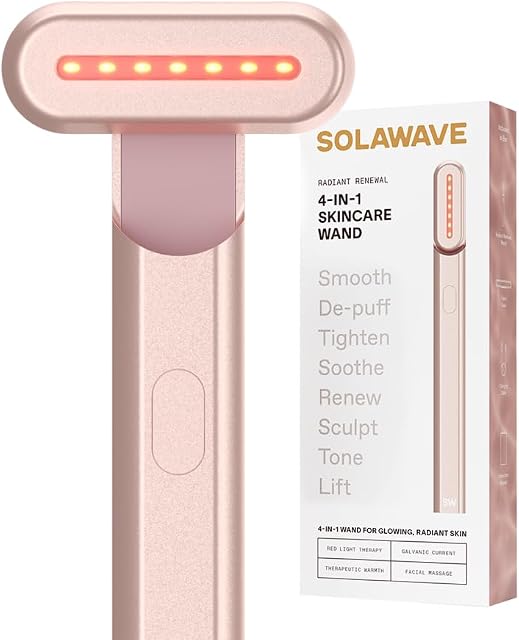
Solawave 4-in-1 Radiant Renewal Wand
Amazon / Solawave / Nordstrom
4.2(830 reviews)
- Leds:
- 14
- Irradiance:
- 49.5–60.5 mW/cm²
- Fda Cleared:
- Yes
- Form Factor:
- Handheld wand
- Wavelengths:
- 630nm (red only)
- Return Policy:
- 60 days
- Treatment Time:
- 3 min per area, 12 min/day, 3-5x/week
- Additional Modes:
- Galvanic current, warmth, vibration
The Solawave wand sits at the intersection of red light therapy and skincare ritual. At 49.5-60.5 mW/cm² from 14 LEDs at 630nm, it clears Wirecutter's minimum irradiance threshold for wands and adds galvanic current, warmth, and vibration into a $118-169 format that WIRED called 'spa-like'. Their testers reported visible eye area skin-tightening within weeks, and the 60-day return window lowers the risk of the initial purchase. WIRED awarded it 'Best Spot Treatment.'
The limitations are structural. Fourteen LEDs in a 0.75 square inch head means covering the same area as a mask requires significantly more time and passes. Single 630nm wavelength only means no near-infrared for deeper tissue penetration – making this a surface skin tool.
Reddit sentiment on r/redlighttherapy is mixed-to-negative for serious goals: one user who tried both Solawave and Omnilux wrote the Solawave 'doesn't make a difference at all' and recommended a panel plus a separate microcurrent device instead. Another noted it 'feels nice' for sinus headaches but produces no meaningful skin results. A rechargeable battery failure mid-session was also reported during Wirecutter's testing. Treat it as an entry point, not a substitute for panel-level treatment area coverage.
What we like
- 4-in-1 functionality (red light + galvanic current + warmth + vibration) – 'spa-like' experience per WIRED testing
- Effective for spot treatment; WIRED testers reported visible eye area skin-tightening within weeks
- 60-day return window – longer than most competitors; low-risk entry point
- Entry-level price at $118–169 for first-time buyers
Worth knowing
- Only 14 LEDs in a 0.75 sq inch head – requires significantly more time/effort to cover the same area as any mask
- Single 630nm wavelength only – no near-infrared for deeper tissue penetration
- Rechargeable battery reportedly failed mid-treatment during Wirecutter testing
- Reddit users directly compare it unfavorably to panels – one stated it 'doesn't make a difference at all'

How to Buy a Red Light Therapy Device: What Actually Matters
Irradiance Is the Only Spec Worth Comparing
Irradiance, measured in milliwatts per square centimeter (mW/cm²), is the amount of light energy delivered per unit area of skin. It is the single most important technical specification for determining whether a device produces therapeutic photon delivery. Wattage tells you how much power a device draws from the wall; it says nothing about delivery efficiency, LED quality, or coverage area. Wirecutter's dermatology experts set minimum thresholds as part of their testing criteria: 30 mW/cm² for soft masks, 50 mW/cm² for hard masks, and 49.5 mW/cm² for wands. Clinical devices typically exceed 100 mW/cm².
A top-voted comment on r/redlighttherapy explains that 'many consumer devices fall way below' those clinical thresholds, and that 'much of the price variation comes down to irradiance output and LED density rather than branding.' Fortune's testing of the Lifepro BioHeal Plus showed why distance matters too: 212 mW/cm² at 3 inches dropped to 140 mW/cm² at 6 inches, a 34% reduction. Any brand advertising a panel's irradiance without specifying the measurement distance is giving you a number that's impossible to use.
What 'FDA Cleared' Actually Means (and What It Doesn't)
FDA clearance appears on nearly every device in this category as a marketing badge. It should not be read as an efficacy signal. Stanford Medicine's dermatologists confirm that FDA clearance 'focuses mainly on safety' and does not validate efficacy claims. The 510(k) pathway grants clearance based on substantial equivalence to a predicate device – not independent clinical trials. A top-voted post on r/redlighttherapy states it directly: 'FDA only requires registration and does not actually review devices.' This explains why a $89 Amazon mask can carry the same 'FDA cleared' badge as a $400 premium mask – the label confirms basic safety testing, not that the device produces therapeutic results.
Wavelength by Use Case: What the Research Supports
Red light in the 630-660nm range works primarily at the skin surface, stimulating collagen production and improving texture. Near-infrared at 810-850nm is invisible to the eye and penetrates significantly deeper into subcutaneous tissue and joint structures, making it better suited for pain management and inflammation. Wirecutter's dermatologist panel notes: 'Red light stimulates collagen and elastin production, while near-infrared reduces oil and inflammation in subcutaneous tissue.' Stanford Medicine confirms longer wavelengths 'help heal or stimulate cell growth or production of collagen-building proteins.' For most buyers, a device offering both wavelengths covers more use cases than a single-wavelength option.
What the research does not robustly support: athletic performance enhancement, weight loss, and erectile dysfunction claims. Stanford Medicine's dermatologists specifically identify athletic performance claims as lacking data. A 1,064nm wavelength marketed by some newer devices targets deeper collagen layers, but a WIRED tester who evaluated the Jovs 4D Laser Mask at its highest 1,064nm setting 'didn't see a difference between using that and lower levels.' Wavelength range is only meaningful when paired with evidence for the specific application – not as a standalone quality signal.
The Biphasic Dose Response: More Is Not Always Better
No major review article covers this, but it's clinically documented in photobiomodulation literature under the Arndt-Schulz law: too much light energy can inhibit the cellular response that lower doses stimulate. Dr. Ruscio described learning this the hard way when high-irradiance early sessions with a panel caused increased joint pain rather than relief. He also warns against treating the same body area simultaneously with both a pad and a panel, which caused him swelling. This is not a theoretical concern. Start with lower irradiance settings and shorter session durations, then increase gradually – and do not assume doubling your session length doubles your benefit.
Format: Panel vs. Mask vs. Handheld
- Panels cover face, neck, chest, back, and joints – and Reddit broadly agrees they produce more substantial results for pain and body applications. They require setup space and a consistent distance, and irradiance drops sharply farther than 6 inches from the surface.
- Face masks provide hands-free treatment at consistent distance with no setup, making them the most convenient daily-routine option for purely facial anti-aging goals. Coverage is limited to the face, and mask format constrains treatment area to what the LED array physically contacts.
- Handhelds are entry-level tools suited for spot treatment. They require significantly more time per area and rarely cover deep tissue due to single-wavelength limitations. They make sense as a first purchase if budget is the primary constraint – not as a replacement for mask or panel-level coverage.
Session Protocols: Frequency and Duration
Most protocols recommend 3-5 sessions per week. Dr. Ruscio recommends panels at 3x per week for 5-15 minutes at roughly 12 inches from the panel. Wirecutter's mask picks recommend 10-minute sessions 3-5x per week. The Dr. Dennis Gross mask needs only 3 minutes daily at its 60 mW/cm² irradiance. Visible skin results typically appear at 4-8 weeks of consistent 3-5x weekly use. Hair growth requires 3-4 months minimum. Joint pain response varies more widely by individual and condition. Consistency matters more than individual session length – a point r/redlighttherapy users emphasize repeatedly.
Skin Protocol: Clean Skin, Then Moisturize After
Apply red light therapy to clean, product-free skin. For wand use, Wirecutter notes wands glide better with a serum, but masks are typically used on bare skin. A highly-voted r/redlighttherapy comment confirms: 'you are supposed to use red light on clean skin, no products, then moisturize and use retinoids after.' One Reddit thread documented apparent skin dryness and new fine lines after a first session, attributed by the community to increased cell turnover (accelerated by RLT) requiring more consistent post-session moisturization and exfoliation rather than a device problem.
At-Home vs. In-Office: What the Difference Actually Is
Stanford Medicine's dermatologists are clear: 'red light therapy delivered in a clinic will almost always be more powerful than any at-home device.' Professional panels typically exceed 100+ mW/cm² with calibrated protocols. Stanford also notes that 'it all depends on the strength and duration of treatment – which is largely unknown when people buy tools for home use.' The practical advantage of home devices is frequency: consistent 3-5x weekly sessions at home, sustained over months, may cumulatively outperform infrequent clinic visits for maintenance purposes. That frequency argument only holds if the device's irradiance clears therapeutic thresholds to begin with.
What we know
- The Lifepro BioHeal Plus delivers 212 mW/cm² irradiance at 3 inches and 140 mW/cm² at 6 inches, a 34% reduction from just 3 additional inches of distance.
- Fortune panel review
- Stanford Medicine confirms FDA clearance for red light therapy devices 'focuses mainly on safety' and does not validate efficacy claims.
- Stanford Medicine (Zakia Rahman MD, Nour Kibbi MD)
- Stanford Medicine dermatologists confirm 'fairly robust evidence' exists for hair growth and wrinkle reduction via red light therapy, but state athletic performance claims 'lack data.'
- Stanford Medicine
- Wirecutter set minimum irradiance thresholds for face mask testing: 30 mW/cm² for soft masks, 50 mW/cm² for hard masks, and 49.5 mW/cm² for wands.
- Wirecutter (NYT)
- A r/redlighttherapy commenter noted that 'many consumer devices fall way below' the 100+ mW/cm² of clinical devices, and that price variation is driven by irradiance output and LED density rather than branding.
- r/redlighttherapy
- Dr. Ruscio documented experiencing increased joint pain during early high-irradiance panel sessions, consistent with the biphasic dose-response (Arndt-Schulz law) documented in photobiomodulation literature.
- Dr. Ruscio
- A r/Biohackers user reported 100% resolution of longstanding tibial tendinitis after one month of red light therapy, after only partial relief from other interventions.
- r/Biohackers
Frequently Asked Questions
- Does red light therapy actually work or is it just a placebo?
- The science is real but narrower than the marketing suggests. Stanford Medicine's dermatologists confirm 'fairly robust evidence' for hair growth and wrinkle reduction via collagen stimulation, supported by RCTs including a PubMed study showing measurable collagen density increases (PMID 24286286). Reddit's r/redlighttherapy community broadly agrees it works for skin and joint pain with consistent use – but stresses that results typically appear at 4-8 weeks minimum, not days. Stanford experts specifically flag athletic performance, erectile dysfunction, and dementia claims as unsupported by current data.
- Is an $89 Amazon red light mask a scam compared to a $400+ option?
- It depends entirely on irradiance. Reddit's r/redlighttherapy community puts it plainly: 'paying $100 is mostly buying a fancy night light' because cheap devices often fall far below therapeutic irradiance thresholds. Wirecutter required a minimum of 50 mW/cm² for hard masks and FDA clearance with a published 510(k) as baseline entry criteria. A commenter on r/redlighttherapy advised against generic Amazon masks outright, noting many are not built to therapeutic standards. That said, 'FDA cleared' only confirms basic safety per Stanford Medicine – not effectiveness. The critical question to ask any device: what is the independently verified irradiance at the distance I'll be using it?
- What wavelength of red light therapy is best for skin and anti-aging?
- For surface skin – collagen, texture, fine lines – 630-660nm visible red is the most researched range with multiple supporting RCTs. Wirecutter's dermatologist panel confirmed 630nm as the minimum effective wavelength for skin. Near-infrared at 830-850nm penetrates deeper into subcutaneous tissue, reducing inflammation and stimulating elastin. Stanford explains that longer wavelengths 'help heal or stimulate cell growth or production of collagen-building proteins.' For most buyers, a device covering both visible red and NIR provides the most versatile coverage across skin and body applications.
- How long does it take to see results from red light therapy?
- For skin texture and fine lines, expect 4-8 weeks of 3-5x weekly sessions before visible improvement. Dr. Ruscio notes skin improvements can appear 'within a few weeks' for panels, while hair growth requires 3-4 months minimum. WIRED's 8-week Shark CryoGlow test confirmed clinically scanned improvements in inflammation, pigmentation, and fine lines after the full protocol. A r/redlighttherapy commenter emphasized that 'consistency matters more than session length' – irregular use produces no visible results, a point supported by multiple Reddit threads.
- Is a red light therapy panel better than a face mask?
- They serve different use cases. Panels cover face, neck, chest, and joints – and Reddit broadly agrees they produce more substantial results for pain and body applications. A r/redlighttherapy user who switched from an Omnilux Contour to a Hooga PRO300 noted better control over specific needs including migraine treatment via neck application. Face masks are more convenient for daily facial anti-aging routines and require no setup, but they're limited to the face. If joint pain, recovery, or multi-area skin treatment is the goal, a panel is the more versatile long-term choice.
- How often should I use red light therapy and for how long per session?
- Most protocols recommend 3-5 sessions per week. Session durations vary by device irradiance: Dr. Dennis Gross's mask needs only 3 minutes at 60 mW/cm², Wirecutter's mask picks recommend 10-minute sessions, and Dr. Ruscio recommends 5-15 minutes for panels at roughly 12 inches. The critical caveat: more is not always better. Dr. Ruscio personally experienced adverse effects from overdoing early high-irradiance sessions, consistent with the biphasic dose-response documented in photobiomodulation research. Start conservatively and build gradually.
- Is red light therapy safe to use on the face? What are the risks?
- Red light therapy is considered safe for most adults at facial irradiance levels – it's non-ionizing and non-thermal at correct power levels. Stanford Medicine confirms the risk of dangerous side effects is 'generally low.' Documented contraindications include lupus, melasma, photosensitizing medications, and light-sensitive eyes. Some Wirecutter testers who are not otherwise light-sensitive experienced headaches from specific masks. One Reddit thread documented apparent temporary skin dryness and fine lines after first use, attributed by the community to increased cell turnover requiring post-session moisturization – it resolved after moisturizing consistently.
- What is irradiance and why does it matter more than wattage?
- Irradiance (mW/cm²) measures the light energy delivered per square centimeter of skin – the number that determines whether your device crosses therapeutic thresholds. Wattage measures total power draw from the wall, not delivery efficiency or coverage area. Wirecutter's experts set minimum irradiance thresholds for each device category as part of their testing criteria. Fortune's independent testing showed irradiance drops dramatically with distance: the Lifepro BioHeal Plus dropped from 212 mW/cm² at 3 inches to 140 mW/cm² at 6 inches. Without the measurement distance specified, any irradiance figure is essentially unusable for dosing decisions.
- Can red light therapy help with joint pain and muscle recovery?
- Near-infrared light at 810-850nm has some of the strongest evidence in photobiomodulation literature for pain and inflammation, including Cochrane-reviewed LLLT studies. Dr. Ruscio notes wearable pads pressed against skin often outperform hanging panels for localized joint treatment due to closer contact distance. A r/Biohackers user with longstanding tibial tendinitis reported complete pain resolution after one month of RLT. A r/redlighttherapy user with endometriosis reported immediate pain reduction on first panel use. Another reported reduced migraine frequency when applying a Hooga panel to the neck and head area.
- Will red light therapy work for weight loss?
- The evidence is not there. Stanford Medicine's dermatologists specifically identify weight loss as one of the 'wilder claims' made about red light therapy – in the same category as applications 'without any scientifically validated results.' No Cochrane review or major clinical trial supports red light as a standalone weight loss tool. Brands marketing fat reduction aggressively appear to be making marketing-driven claims rather than evidence-based ones. If weight loss is the primary goal, red light therapy is not a supported intervention.
- Should I use red light therapy on clean skin or with serums and moisturizers?
- Apply red light therapy to clean, product-free skin, then apply serums or moisturizer afterward. For wand devices, Wirecutter notes they glide better with a serum applied – but masks are typically used on bare skin. A highly-upvoted r/redlighttherapy comment confirms the protocol: 'you are supposed to use red light on clean skin, no products, then moisturize and use retinoids after.' The community attributes post-session skin dryness reported by some first-time users to increased cell turnover accelerated by RLT, requiring more consistent post-session moisturization.
- Is at-home red light therapy as effective as in-office treatments?
- At-home devices are less powerful than clinical equipment in virtually all cases. Stanford Medicine is direct: 'red light therapy delivered in a clinic will almost always be more powerful than any at-home device.' Stanford also notes that 'it all depends on the strength and duration of treatment – which is largely unknown when people buy tools for home use.' The practical value of home devices is frequency: consistent 3-5x weekly sessions sustained over months may cumulatively outperform infrequent clinic visits for skin maintenance. That frequency advantage only holds if the device's irradiance clears therapeutic thresholds to begin with.
Related articles
