Senior Cat Litter Box: What Actually Matters
Researched by Sage
This article contains affiliate links. We may earn a commission at no extra cost to you. See our disclosure.
The One Spec Most Reviews Ignore
Most litter box reviews spend two paragraphs on odor containment and zero sentences on entry height. For a healthy, agile cat, that's fine. For a senior cat with arthritis, a large-breed cat that doesn't fit in a standard box, or any cat recovering from surgery, entry height is the single most important spec on the sheet – and it's almost never listed.
The research is clear: senior and arthritic cats need an entry height of no more than 4.8 inches (12 cm), and ideally under 2 inches (5 cm) for cats with severe arthritis or limited mobility, according to guidance from Meowant and Litter-Robot's senior cat resources. The box interior should also be at least 1.25 times the cat's body length and 1.2 times their width to allow comfortable turning without painful leg lifts. If a cat can't get in without discomfort, it will find somewhere else to go – and that's not a behavior problem, it's a pain response.
Designs That Actively Fail Senior and Large-Breed Cats
Top-entry boxes are the most common failure mode for aging and mobility-impaired cats. The Large Top-Entry Enclosed Hooded Litter Box has 33,900 reviews and a 4.5-star rating. It is genuinely excellent at scatter prevention. It is explicitly unsuitable for senior, arthritic, or large-breed cats. Jumping up and down from a top-entry opening puts stress on hips and front legs – exactly the joints that hurt in an arthritic cat. Cats.com confirms this category outright: top-entry designs are a hard no for cats with joint issues.
Standard enclosed hooded boxes with a front entry flap are the second-most common failure. The flap itself requires the cat to push through with their head and shoulders – an awkward motion for a stiff cat – and on most designs the cat still has to step over a meaningful barrier to enter.
For large breeds, the size problem is different. Maine Coons run 18 to 22 inches in body length. According to Meowant's large-breed research, these cats need a minimum internal turning diameter of 20 inches to rotate 180 degrees without spinal compression. In automatic globe-style boxes, internal waste dividers can reduce usable floor space by 15 to 20 percent – which means the advertised capacity is not the actual usable space.
Automatic Litter Box Safety: The Design Detail That Actually Matters
The safety question around automatic litter boxes gets treated as a yes/no issue. It isn't. The safety concern is almost entirely about one specific design feature: closing mechanisms. A highly upvoted thread in r/cats (32,000+ upvotes) puts it plainly – the top comment, with 2,196 upvotes, states that self-scooping boxes with closing doors are the ones responsible for cat injuries and deaths. Open-design boxes, where the entry stays accessible throughout the cleaning cycle, do not carry this risk.
Generic models sold under rotating brand names on Amazon – Figo Pet Insurance documents several including Amztoy, Catlk, CozyBlue, and Kikquze – frequently feature these closing-door designs. When sensors fail on these units, the closing mechanism continues operating. Reputable brands like Litter-Robot use globe-style rotation with weight sensors that pause the cleaning cycle when a cat is present. Open-top designs like the PetPivot Autoscooper 11 physically cannot trap a cat because the entry remains open at all times.
For senior cats specifically, the open-top or open-entry automatic design also reduces anxiety: the cat can see its surroundings during the cycle rather than being enclosed in a globe. The Refined Feline's safety breakdown confirms that redundant sensor systems – combining weight sensors and infrared detection – provide the most reliable protection, while single-sensor designs leave more room for failure.
What to Look for in a Senior Cat Litter Box
- Entry height under 4.8 inches. This is the ceiling for arthritic cats; under 2 inches is better for severe cases. Dropped-entry designs – where one wall is cut lower than the rest – are specifically built for this.
- High sides (13 to 14 inches) combined with low entry. High sides contain urine spray without requiring a high step-in. These aren't mutually exclusive features.
- Interior floor space: 1.25x the cat's body length, 1.2x their width. A cramped box means painful posturing. For a 20-inch cat, that's a 25-inch interior minimum.
- No top-entry. Full stop. Jumping up and climbing down puts direct stress on arthritic hips and shoulders.
- No closing-mechanism automatic designs. For senior cats already cautious about new equipment, an enclosure that closes on them is a fast path to litter box avoidance.
- Ramp compatibility. For cats with very limited mobility, some automatic boxes (Litter-Robot included) offer optional ramp accessories that further reduce the entry step.
Recommended Senior Cat Litter Boxes
The products below are filtered specifically for senior, arthritic, and large-breed cats – meaning low entry, adequate interior floor space, and no closing mechanisms. Not every product in the full category belongs here.
Best Automatic Option for Senior Cats
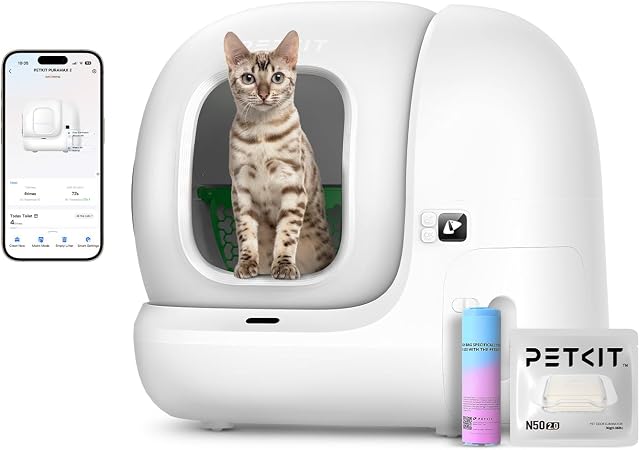
PETKIT PuraMax 2 Automatic Self-Cleaning Litter Box
Amazon
- Type:
- Automatic self-cleaning
- Entry:
- Low entrance
- Safety:
- Safety sensors, anti-leakage
- Price Tier:
- Mid-range
- Connectivity:
- 2.4G WiFi / App control
The PETKIT PuraMax 2 is one of the few automatic litter boxes that specifically engineers a low entrance – a feature WIRED called out as practical for cats that can't manage a high step. At $299.99, it's the most accessible globe-style automatic option for this use case. The failure modes are real: some users report weight sensor inaccuracies and waste bin fitting issues, and litter spillage has been flagged in reviews. But for a cat that genuinely needs a low entry with an automated cleaning cycle, the options are limited and this one is the most tested.
What we like
- Most affordable PetKit globe model at $299.99 – good value vs Litter-Robot
- Low entrance design ideal for senior or arthritic cats
- Anti-leakage design with solid app integration
- WIRED recommended as 'Best Basic' automatic litter box for most people
Worth knowing
- Weight sensor issues reported by multiple users
- Waste bin fitting problems noted in some reviews
- Litter dumping/spillage concerns flagged by users
- 2.4G WiFi only – slower connectivity than Purobot Max Pro 2's 5G
Best Budget Automatic for Senior Cats

PetPivot Autoscooper 11
Amazon
- Type:
- Automatic self-cleaning
- Entry:
- Easy step for senior cats
- Design:
- Open top
- Price Tier:
- Budget
- Safety Feature:
- Anti-pinch protection
- Safety Sensors:
- 7 pairs of safety sensors
The PetPivot Autoscooper 11 is WIRED's pick for best budget automatic litter box, and its design choices make sense for senior cats specifically: open-top construction (no closing mechanism), an easy-step entry, and 7 pairs of safety sensors at a $129 to $150 price point. The review count is thin at 13 to 15 Amazon reviews, so long-term reliability is genuinely unknown. But the design architecture is right – open entry, no entrapment risk, step built for reduced mobility.
What we like
- Budget-friendly at $129–$150 – lowest price among automatic options
- 7 pairs of safety sensors – more than most competitors in price range
- Anti-pinch protection and open-top design address safety concerns
- Easy-step entry design suitable for senior or mobility-impaired cats
Worth knowing
- Limited review data – 13–15 reviews on Amazon listings
- Newer, less-established brand
- Fewer advanced features (no camera, basic app)
Best Premium Automatic for Large Breeds

PetKit Purobot Max Pro 2
Amazon
- Type:
- Automatic self-cleaning
- Entry:
- Extra large opening
- Camera:
- AI camera, 210° wide-angle lens
- Price Tier:
- Premium
- Connectivity:
- 5G WiFi
- Facial Recognition:
- Yes — cat identification
The PetKit Purobot Max Pro 2 has the largest opening of any globe-style automatic box in this category, which matters for large breeds that can't comfortably enter a standard-size globe. WIRED named it best automatic litter box overall. The AI camera with facial recognition also allows per-cat health tracking in multi-cat households, which becomes more valuable as cats age and health monitoring increases in importance. The review count is low (169 Amazon reviews) and early users have flagged weight sensor issues – standard caution applies for any newer model.
What we like
- AI camera with 210° wide-angle lens and facial recognition for multi-cat identification
- 5G WiFi for faster, more reliable app connectivity
- Extra-large opening accommodates large breed cats
- Advanced waste tracking and health monitoring per individual cat
Worth knowing
- Limited review data at 169 Amazon reviews – newer model
- Weight sensor issues reported by some early users
- Reliability concerns noted in user reports for a newer model
- Premium pricing comparable to Litter-Robot 4
Best Manual Option for Senior or Large Cats

iPrimio XL Stainless Steel Litter Box with Lid
Amazon
- Lid:
- Yes
- Size:
- XL — 23.5 x 15.5 x 6 in
- Type:
- Manual enclosed
- Sides:
- High-sided
- Material:
- Stainless steel
- Rust Resistant:
- Yes
The iPrimio XL Stainless Steel Litter Box earns a 4.6-star rating across 6,200 Amazon reviews. At 23.5 x 15.5 inches, it gives large breeds actual room to turn. Stainless steel doesn't absorb urine odors the way plastic does – plastic develops micro-scratches from scooping that harbor bacteria and require box replacement every one to two years, while stainless can last a decade. The lid provides odor containment and some scatter reduction. This is a manual box, which means you're still scooping – but for a senior cat that needs a predictable, low-stress environment without automated noise and movement, consistency matters.
What we like
- Excellent 4.6★ rating across 6,200+ Amazon reviews – proven reliability
- Stainless steel is non-porous – won't absorb odors or harbor bacteria like plastic
- Rust-resistant and highly durable – long-term investment
- XL size accommodates large breed cats comfortably
- Easy to clean – wipe down vs scrubbing plastic
Worth knowing
- Manual scooping required – no automation
- Heavier than plastic alternatives
- Higher upfront cost vs plastic boxes
Also Worth Considering

Homerunpet CS106 Ultra Large Automatic Litter Box
Amazon
- Type:
- Automatic self-cleaning
- Safety:
- Physical anti-pinch (not sensor-based)
- Capacity:
- Ultra large
- Use Case:
- Multi-cat homes
- Price Tier:
- Mid-premium
- Connectivity:
- App control
The Homerunpet CS106 uses a physical anti-pinch mechanism rather than sensor-based safety, which removes one common failure mode from the equation – but with only about 12 reviews on Amazon and pricing up to $799, it's a hard recommendation to make with confidence yet.

Petlibro Luma Self-Cleaning Litter Box
Amazon
- Type:
- Automatic self-cleaning
- Camera:
- AI camera with waste analysis
- Design:
- Open top
- Multi Cat:
- Yes — individual cat recognition
- Price Tier:
- Premium
- Odor Control:
- Auto odor-control system
The Petlibro Luma has an open-top design that reduces enclosure anxiety – useful for senior cats that are wary of globe-style boxes – and its large capacity suits bigger breeds. At $599.99 with only 220 reviews, long-term reliability is still an open question.
Frequently Asked Questions
- What entry height does a senior cat litter box need?
- Senior and arthritic cats need an entry height of no more than 4.8 inches (12 cm), and ideally under 2 inches (5 cm) for cats with severe arthritis or short legs, according to Meowant's senior cat guidance and Litter-Robot's resources for aging cats. Boxes with a dropped-entry design – where one wall is cut lower than the sides – are specifically built for this requirement. Standard enclosed hooded boxes with a front flap typically fail this threshold.
- Are automatic litter boxes safe for senior cats?
- It depends entirely on the design. Automatic boxes with closing mechanisms are the ones associated with cat injuries and deaths – open-design boxes, where the entry stays accessible during the cleaning cycle, do not carry this risk, as documented in a highly upvoted r/cats thread (32,000+ upvotes). For senior cats, open-top or always-open-entry automatic designs are the right choice: they prevent entrapment and reduce the anxiety of being enclosed in a dark globe. Redundant sensor systems (weight + infrared) provide the most reliable protection against accidental cycling while a cat is inside.
- What size litter box does a large cat need?
- Large breeds like Maine Coons (18 to 22 inches body length) need a minimum internal turning diameter of 20 inches, according to Meowant's large-breed research. Cats.com and Petroom both confirm the practical sizing target: 24 to 30 inches interior length and 18 to 22 inches width. Advertised capacity in automatic globe-style boxes can be misleading – internal waste dividers often reduce usable floor space by 15 to 20 percent. Always measure interior dimensions, not exterior.
- Are top-entry litter boxes suitable for senior cats?
- No. Top-entry boxes require cats to jump up and climb down, which puts direct stress on arthritic hips, shoulders, and front legs. Cats.com's senior litter box review explicitly rules out top-entry designs for cats with joint issues. The Large Top-Entry Enclosed Hooded Litter Box has 33,900 reviews and is excellent for scatter prevention – but it is not appropriate for any cat with mobility limitations.
- How many litter boxes do I need for 2 cats?
- Three. Vets and feline behaviorists universally recommend the N+1 rule: one box per cat plus one extra. PetMD, Purina, and MudBay all confirm this. Some cats refuse to share, and territorial guarding of a single box causes litter box avoidance – which, in senior cats, can be misread as a medical problem when it's actually a resource problem. A single automatic litter box, regardless of price, does not substitute for the N+1 count in multi-cat homes.
- What litter should I use with an automatic litter box?
- Most automatic litter boxes require standard clumping litter – non-clumping litter jams raking and rotating mechanisms. Crystal or silica gel litters work with some designs but not globe-style units. Pellet litters (pine, paper) are generally incompatible with automatic rakes. The Litter-Robot brand sells compatible Purina Tidy Cats clumping litter through its Amazon channel. WIRED's reviewers tested units with standard clumping litter.
- Is stainless steel better than plastic for a senior cat's litter box?
- For long-term use, yes. Stainless steel is non-porous – it doesn't absorb urine odors or harbor bacteria in micro-scratches the way plastic does. Plastic boxes develop micro-scratches from scooping within months, which trap odor-causing bacteria, and typically need replacement every one to two years. The iPrimio XL Stainless Steel box (4.6 stars, 6,200 reviews) costs more upfront than the IRIS plastic box, but the cost-per-year over a decade is lower. Amazon's Choice stainless steel options start at $47.59 – $28 more than the most popular plastic box.
- Will a senior cat use an automatic litter box?
- Many do, with the right introduction. Litter-Robot's official guidance states that over 95% of cats acclimate within days to weeks when introduced correctly: box unplugged for three to five days next to the old box, familiar litter scent added, and automated cycles only started after the cat uses it unassisted. For senior cats that are sensitive to noise and unexpected movement, open-top designs tend to have faster acceptance than enclosed globe designs. Keep the old box available throughout the transition – removing it too early is the most common reason cats skip the new one.
Related articles


