- Product
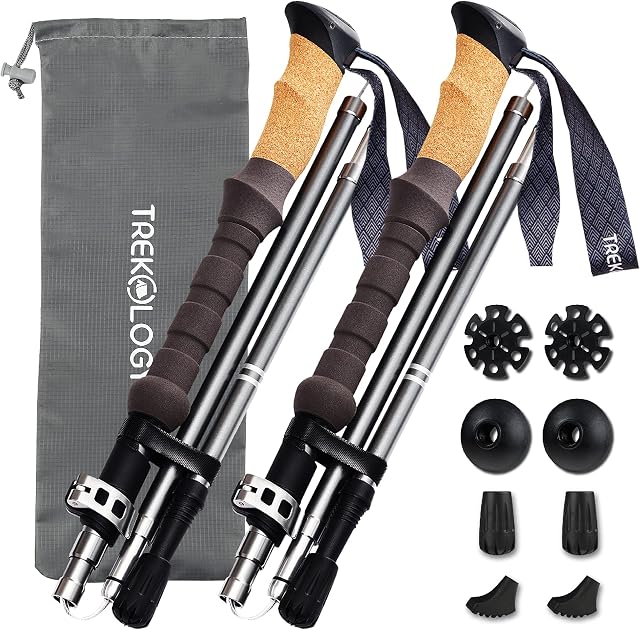
- TREKOLOGY Trek-Z Cork Grip
- Material
- Aluminum
- Design
- Folding
- Lock Type
- Internal cord
- Best For
- Budget hikers, travel
Best Trekking Poles for Every Hiker and Budget
Researched by Atlas
·16 min read
This article contains affiliate links. We may earn a commission at no extra cost to you. See our disclosure.


Quick Picks
Trekking poles are not one-size-fits-all gear. A trail runner needs a fast-deploy folding pole that stows in seconds; a 50-something descending rocky switchbacks needs FlickLock adjustability and cork grips that won't slip when sweaty. The picks below span aluminum budget options, mid-range carbon, and premium branded poles from Black Diamond and LEKI – each matched to the hiker who'll actually get the most out of it.
- Material
- Aluminum
- Design
- Foldable
- Lock Type
- Metal flip locks
- Best For
- Mid-budget, mixed grip
- Material
- Carbon fiber
- Design
- Collapsible
- Lock Type
- Flip locks
- Best For
- Carbon value seekers
- Material
- Carbon fiber
- Design
- Collapsible
- Lock Type
- Quick adjustable locks
- Best For
- Budget carbon, high review count
- Material
- Aluminum
- Design
- Telescoping
- Lock Type
- FlickLock
- Best For
- Trusted brand, all-season
- Product
- Black Diamond Trail Back
- Material
- Aluminum
- Design
- 3-section telescoping
- Lock Type
- FlickLock
- Best For
- BD entry-level, backpacking
- Product
- Black Diamond Distance Z
- Material
- Carbon fiber
- Design
- Foldable Z-pole
- Lock Type
- Fixed (size-based)
- Best For
- Trail runners, ultralight
- Material
- Carbon fiber
- Design
- Foldable
- Lock Type
- FlickLock Z (FLZ)
- Best For
- Women, ultralight adjustable
- Product
- Ultratrail FX.One
- Material
- Carbon fiber
- Design
- Foldable
- Lock Type
- Adjustable
- Best For
- Premium trail running/hiking
- Product
- LEKI Makalu FX Carbon AS
- Material
- Carbon fiber
- Design
- Foldable/collapsible
- Lock Type
- SpeedLock Plus
- Best For
- Lifetime warranty, premium
- Material
- Carbon fiber
- Design
- Telescoping
- Lock Type
- FlickLock
- Best For
- Alpine, cork grip, durable
- Material
- Carbon fiber
- Design
- Collapsible
- Lock Type
- Adjustable
- Best For
- Mid-price carbon, no-brand value
Full Reviews
TREKOLOGY Trek-Z Cork Grip Trekking Poles – Best Budget Pick
TREKOLOGY Trek-Z Cork Grip Trekking Poles
Amazon
4.5(7,000 reviews)
- Design:
- Folding/foldable
- Material:
- Aircraft-grade aluminum
- Grip Type:
- Cork
- Packability:
- Compact travel design
- Adjustability:
- Adjustable height
OutdoorGearLab named the Trek-Z their 'Best Budget Pick' after independently testing it against 19 other poles – that's not an Amazon badge, it's a real competitive field test. The cork grips separate it from most aluminum budget poles, which typically use foam or rubber. Cork absorbs moisture and molds to your hand over time, and at this price point that's a genuine differentiator. Over 7,000 reviews at 4.5 stars on Amazon confirms it isn't just a reviewer darling – it holds up across a large, varied buyer base.
The folding design packs down compactly enough to fit in a carry-on, which matters for hikers who fly to trailheads. The tradeoff is structural: folding poles have an internal cord connecting the sections, which introduces more potential failure points than a straight telescoping shaft. This isn't the pole for someone shouldering a 50-pound pack through technical terrain. For day hikes, moderate trail use, and travel, the Trek-Z is the sharpest value in the sub-$50 bracket. r/hiking users also flag it as a top pick for its packability and cork grip combination.
What we like
- OutdoorGearLab 'Best Budget Pick' – independently tested against 19 other poles
- Cork grips absorb moisture and reduce hand fatigue on long hikes
- Folding design packs down compactly for travel and plane carry-on
- 7,000+ reviews at 4.5 stars demonstrates consistent buyer satisfaction
Worth knowing
- Aluminum construction adds weight compared to carbon fiber models
- Folding design has more potential failure points than telescoping poles
- Not ideal for heavy loads or aggressive backcountry use
Premium Foldable Hiking Poles by USA Brand – Best Budget Metal Flip Lock
Premium Foldable Hiking Poles by USA Brand
Amazon
4.6(2,300 reviews)
- Design:
- Foldable
- Material:
- Aircraft aluminum
- Grip Type:
- Cork and EVA foam
- Lock Type:
- Metal flip locks
- Adjustability:
- Adjustable
The 'USA Brand' labeling is admittedly vague, and that's worth acknowledging upfront. What's less vague is the hardware: metal flip locks instead of plastic at this price point, which is a meaningful durability upgrade over similarly priced poles. Dual grip options – cork upper and EVA foam lower – give you the moisture management of cork for the primary grip position and the cushioning of foam for extended low-hand placements on steep terrain. At 4.6 stars across 2,300+ reviews, the performance track record is solid even if the brand identity isn't.
For hikers who prioritize hardware quality over brand recognition and want a foldable pole that collapses smaller than a standard telescoping set, this lands between the Trek-Z and the branded Black Diamond options. The aluminum construction means it carries more weight than carbon alternatives, which becomes noticeable on full-day efforts. But for moderate hiking frequency, the metal flip lock durability advantage over plastic alternatives is a real functional benefit, not marketing language.
What we like
- High 4.6-star rating across 2,300+ reviews – strong mid-budget performance
- Metal flip locks more durable than plastic alternatives at this price point
- Dual grip options (cork + EVA foam) for varied hand placement preferences
- Foldable design packs down smaller than telescoping poles
Worth knowing
- Aluminum construction – heavier than carbon fiber options
- Fewer reviews than top-tier budget competitors like TrailBuddy
- Brand identity unclear – 'USA Brand' marketing may concern some buyers
100% Carbon Fiber Trekking Poles by USA Brand – Budget Carbon Value
100% Carbon Fiber Trekking Poles by USA Brand
Amazon
4.7(3,200 reviews)
- Design:
- Collapsible
- Material:
- 100% carbon fiber
- Grip Type:
- Cork and EVA foam
- Lock Type:
- Quick adjustable flip locks
- Adjustability:
- Adjustable height
Carbon fiber at under $60 is the central fact here. Most carbon poles from recognized brands start at $120 and climb fast. This pole delivers the material with quick flip locks and dual cork-plus-EVA foam grips, and its 4.7-star rating across 3,200 reviews is the strongest rating-to-review-count combination among unbranded carbon options in this list. For a weight-conscious hiker who can't stretch to Black Diamond pricing, it's a credible option.
The critical tradeoff with carbon at any price point: lateral impact resistance. Carbon poles are, as r/Ultralight users note, strong in the axial direction but most real-world breaks come from sideways falls that stress the shaft laterally. Carbon shatters rather than bends. With an unbranded pole, there's no warranty infrastructure to back a replacement. That's a fine tradeoff for a hiker who wants light weight on maintained trails and accepts the risk; it's a worse tradeoff for rocky, technical routes where a pole-catching fall is likely.
What we like
- Carbon fiber construction at under $60 – exceptional value for the material
- 4.7 stars across 3,200 reviews demonstrates sustained quality at this price
- Quick flip locks allow fast length adjustments on the trail
- Dual grip (cork + EVA foam) provides moisture management and comfort
Worth knowing
- Carbon fiber can shatter/snap under lateral impact rather than bending like aluminum
- Generic 'USA Brand' branding lacks brand support infrastructure of LEKI or Black Diamond
- Limited warranty information available
Carbon Fiber Hiking Sticks with Quick Adjustable Locks – Most-Reviewed Budget Carbon

Trekking Poles - Carbon Fiber Walking or Hiking Sticks with Quick Adjustable Locks
Amazon
4.6(6,400 reviews)
- Design:
- Collapsible
- Material:
- Carbon fiber
- Lock Type:
- Quick adjustable locks
- Adjustability:
- Adjustable height
With 6,400+ reviews at 4.6 stars and an Amazon's Choice designation, this is the highest-volume unbranded carbon pole available in the mid-range. At $65, it undercuts most branded carbon poles significantly, and the quick-adjustable locks allow height changes without tools. The section count and collapse design are standard collapsible format, which is more rigid than a folding Z-pole but less packable.
The anonymity of the brand is a legitimate concern, not a nitpick. If the pole fails in the field or needs a warranty claim, there's no LEKI or Black Diamond customer service desk to call. The spec sheet also lacks the detail of named brands, making head-to-head comparisons harder. That said, for a hiker who wants carbon weight savings on a tight budget and hikes terrain where lateral pole impacts are rare, the review volume here provides more real-world confidence than a single gear tester's opinion.
What we like
- 6,400+ reviews at 4.6 stars – one of the most-reviewed carbon poles in the mid-range
- Amazon's Choice designation validates broad buyer satisfaction
- Carbon construction at $65 undercuts most branded carbon poles by 50%+
- Quick adjustable locks allow terrain-specific height changes without tools
Worth knowing
- Anonymous branding limits accountability for warranty or customer support
- Carbon fiber will snap rather than bend if caught sideways in a fall
- Limited spec detail makes feature comparison with named brands difficult

Black Diamond Trail Trekking Poles (Aluminum) – Most Reliable Flick-Lock Aluminum

Black Diamond Trail Trekking Poles (Aluminum)
Amazon
4.6(595 reviews)
- Season:
- All-season design
- Material:
- Lightweight aluminum
- Grip Type:
- Natural, cork, or foam (variant-dependent)
- Lock Type:
- FlickLock adjustable
- Adjustability:
- Adjustable length
The Black Diamond Trail is the benchmark aluminum pole for hikers who want brand accountability, a real warranty, and a locking system that won't slip. Black Diamond's FlickLock is an external lever-clamp that locks the shaft length without relying on internal friction – which means it doesn't degrade when wet, cold, or gritty. r/hiking users consistently name Black Diamond and LEKI as the two most trusted brands for all-around reliability, and the FlickLock mechanism is a primary reason. At 4.6 stars across 595 reviews, the consistency holds across a meaningful sample.
The aluminum construction does mean more oz per pair compared to Black Diamond's own carbon lineup. At around $98, you're also close to the price of lighter carbon alternatives from unbranded sellers. The value proposition here is specifically the combination of proven lock mechanism, multi-grip variants for different climates, and a 2-year manufacturer warranty with an actual support structure behind it. For the hiker who's been burned by a plastic-lock pole failing mid-descent, that's not a trivial distinction.
What we like
- Black Diamond's FlickLock mechanism is widely regarded as the most reliable locking system on the market
- 595 reviews at 4.6 stars demonstrates consistent satisfaction across a large sample
- All-season design with multiple grip options for different climates and preferences
- Black Diamond's brand reputation and 2-year warranty provide reliable support
Worth knowing
- Aluminum construction makes these heavier than Black Diamond's carbon offerings
- At ~$98, priced similarly to lighter carbon alternatives from lesser-known brands
- FlickLock adjustment requires stopping to re-lock – less convenient than twist-lock on the move
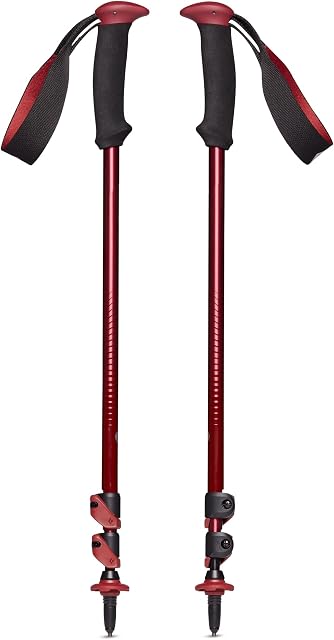
Black Diamond Trail Back Trekking Poles – BD Entry-Level Pick
Black Diamond Trail Back Trekking Poles
Amazon
4.5(148 reviews)
- Design:
- 3-section telescoping
- Material:
- Durable aluminum
- Grip Type:
- Comfortable grip
- Lock Type:
- FlickLock adjustable
- Intended Use:
- Hiking and backpacking
The Trail Back is the entry point into the Black Diamond lineup, sitting around $70 and carrying over the same FlickLock system from higher-end BD models. Three-section telescoping with aluminum construction means it handles rocky and technical terrain reliably. For a hiker who wants Black Diamond quality assurance without paying for carbon or additional grip variants, it's the logical starting place.
At 148 reviews, the Trail Back has a thinner track record than the Trail. The aluminum adds weight relative to BD's carbon Distance Z, which is available for roughly $50 more. If you're already leaning toward investing in this brand, the upgrade math toward the Distance Z or Trail aluminum is worth running. The Trail Back earns its place for hikers who need the FlickLock and brand warranty at the lowest BD entry cost.
What we like
- Black Diamond brand quality with FlickLock reliability at a more accessible $70 price point
- Entry point into the Black Diamond lineup for hikers not ready to invest in carbon
- FlickLock system inherited from premium BD models ensures secure length adjustment
- Durable aluminum construction handles rocky and technical terrain reliably
Worth knowing
- Relatively low review count (148) compared to top-tier Black Diamond models
- Aluminum adds weight vs. Black Diamond's carbon Distance Z at only $50 more
- Fewer grip and basket options than higher-end Black Diamond Trail poles
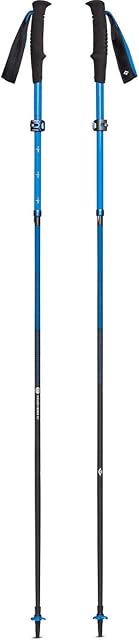
Black Diamond Distance Z Trekking Poles – Best for Trail Runners and Ultralight Hikers
Black Diamond Distance Z Trekking Poles
Amazon
4.4(96 reviews)
- Design:
- Foldable Z-pole
- Material:
- Carbon fiber
- Intended Use:
- Trail running and hiking
- Weight Class:
- Ultralight
- Adjustability:
- Fixed length (size-based selection)
Two independent expert sources have flagged this pole specifically: iRunFar ranked it #1 for trail runners and ultrarunners after testing 12+ lightweight poles, and OutdoorGearLab named it 'Best Value' across their full test field of nearly 70 unique pairs since 2012. TheBigOutside also places it among the top premium ultralight options. That's not a coincidence – the Z-pole foldable design deploys and stows faster than any telescoping mechanism, which is decisive for run-hike intervals where poles need to be in and out of a vest pocket repeatedly.
The fixed-length design is a real constraint for general hikers. You select a size at purchase and that length doesn't change mid-hike – no shortening for steep climbs, no lengthening for long descents. For a trail runner who sets pole length once and uses them consistently, that's irrelevant. For a backpacker moving through varied terrain with heavy load who relies on length adjustment, it's a dealbreaker. r/hiking users note the Distance Z is best suited for runners and fast-packers rather than traditional hikers. Price ranges from $120 to $175 depending on color and size variant.
What we like
- Ranked #1 by iRunFar for trail runners and ultrarunners – the top expert endorsement in that category
- OutdoorGearLab 'Best Value' pick among all poles tested across nearly 70 pairs since 2012
- Z-pole foldable design deploys and collapses rapidly – ideal for run-hike intervals
- Carbon construction keeps weight minimal for fast-and-light applications
- Also top-ranked by TheBigOutside among premium ultralight options
Worth knowing
- Fixed-length Z-pole design cannot be adjusted mid-hike for terrain changes
- Higher price point ($120–$175 depending on color/size variant)
- Lower review count on individual ASINs due to color/size variant splitting
- Not ideal for casual hikers who want adjustable length for varied terrain
Black Diamond Women's Distance Carbon FLZ Trekking Poles – Best for Women Hikers

Black Diamond Women's Distance Carbon FLZ Trekking Poles
Amazon
4.7(11 reviews)
- Design:
- Foldable
- Material:
- Carbon fiber
- Length Range:
- 95–110 cm (women-specific)
- Weight Class:
- Ultralight
- Adjustability:
- Adjustable length (FLZ system)
The women-specific sizing (95–110 cm) addresses a genuine fit problem: many unisex poles run long for shorter hikers, creating awkward elbow angles that undercut the knee-offloading benefit poles are supposed to deliver. The FLZ system (FlickLock Z) solves the only real complaint about folding poles – fixed length – by combining a folding section design with FlickLock adjustability. You get the fast deployment of a folding pole and the mid-hike length flexibility of a telescoping one.
The review count is thin at 11 reviews, which means the 4.7-star rating can't carry the same statistical weight it would on a 500-review product. At $175, it's a premium purchase with limited long-term reliability data in the public record. The narrow 95–110 cm range also won't suit taller women. For a shorter-statured woman doing multi-day hiking who wants ultralight carbon with the FLZ system and proper sizing, there's no closer match in this list – but the thin review base warrants caution for risk-averse buyers.
What we like
- Women-specific sizing (95–110 cm) avoids the common 'unisex pole too long' problem for shorter hikers
- FLZ (FlickLock Z) combines the packability of a folding pole with FlickLock adjustability – best of both systems
- Carbon fiber keeps weight minimal for women seeking ultralight setup
- 4.7-star rating, though from limited review sample
Worth knowing
- Only 11 reviews – insufficient data to draw firm conclusions about long-term reliability
- Premium price ($175) for a women-specific niche product
- Narrow size range (95–110 cm) won't suit taller women hikers
Ultratrail FX.One Trekking Poles – Premium Foldable for Run-Hike Use

Ultratrail FX.One Trekking Poles
Amazon
4.7(225 reviews)
- Design:
- Foldable
- Material:
- Carbon fiber
- Intended Use:
- Hiking and trail running
- Weight Class:
- Ultralight
- Adjustability:
- Adjustable
The Ultratrail FX.One carries the strongest rating-to-review-count combination among premium foldable poles: 4.7 stars across 225 reviews. That's enough data to take seriously. The foldable carbon design targets the same trail running and fast-packing use case as the Black Diamond Distance Z, with adjustability added into the folding format – similar in concept to Black Diamond's FLZ system but from a separate brand.
At $220, the pricing is the issue. It costs roughly $50 more than the high end of the Distance Z range, and Black Diamond's name carries more community credibility and documented support infrastructure. Ultratrail has less brand recognition among mainstream hikers, and no competing source has independently ranked it above the Distance Z in head-to-head testing. For a hiker specifically looking for a premium foldable from outside the Black Diamond ecosystem, it's a credible option – but the value case over the Distance Z requires some justification.
What we like
- 4.7 stars across 225 reviews – strongest review count and rating combination among premium foldable poles
- Foldable carbon design optimized for both hiking and trail running versatility
- Ultralight construction suits fast-packing, thru-hiking, and ultrarunning use cases
- Premium build quality reflected in consistent high ratings at significant review volume
Worth knowing
- At $220, among the most expensive poles in the entire category
- Similar performance to Black Diamond Distance Z at roughly $50 more
- Lesser brand recognition than Black Diamond or LEKI among mainstream hikers
LEKI Makalu FX Carbon AS Trekking Poles – Lifetime Warranty Premium Pick

LEKI Makalu FX Carbon AS Trekking Poles
Amazon
4.6(123 reviews)
- Design:
- Foldable/collapsible
- Material:
- Carbon fiber
- Weight Class:
- Lightweight
- Adjustability:
- Adjustable
- Brand Warranty:
- Lifetime warranty
LEKI's lifetime warranty is the single most-discussed differentiator in r/hiking threads comparing LEKI to Black Diamond. The Makalu FX Carbon AS is the flagship foldable carbon model that carries that warranty, paired with LEKI's SpeedLock Plus system for one-handed rapid length adjustment – a similar external-lever principle to FlickLock but LEKI's implementation. At 4.6 stars across 123 reviews, consistency at the premium tier is confirmed, if at a modest sample size.
At $249, this is the most expensive pole in the list. The honest counterargument, raised directly in r/hiking discussions, is that quality poles like the Black Diamond Alpine Carbon Cork have documented 8+ years of regular use without failure – raising the question of whether a lifetime warranty matters if the product outlasts most buyers' active hiking phases anyway. The LEKI warranty has real value for frequent, hard-use hikers who want a no-questions-asked replacement claim for expensive carbon poles. For moderate recreational hikers, it's a premium that may not translate into practical benefit.
What we like
- LEKI's lifetime warranty applies to this model – strongest warranty in the category
- 4.6 stars across 123 reviews demonstrates quality consistency at the premium tier
- LEKI's SpeedLock Plus system allows rapid length adjustment with one hand
- Foldable carbon construction balances packability with premium trail performance
Worth knowing
- At $249, the most expensive pole in our research – hard to justify over Black Diamond Distance Z at $120–$175
- Lifetime warranty only valuable if LEKI honors international/long-term claims
- Premium price puts it out of reach for most recreational hikers
Black Diamond Alpine Carbon Cork Hiking Poles – Long-Term Durability Benchmark

Black Diamond Alpine Carbon Cork Hiking Poles
Amazon
4.5(405 reviews)
- Material:
- Carbon fiber
- Grip Type:
- Cork
- Lock Type:
- FlickLock
- Adjustability:
- Adjustable telescoping
- Product Status:
- Discontinued (new model available)
The Alpine Carbon Cork is discontinued – Black Diamond's product page now returns a 404, and the successor model is the current buy. That said, this pole has the most documented long-term user durability data of anything in this list. r/hiking users report 8+ years of regular use in excellent condition, which is meaningful real-world evidence. Natural cork grips provide superior moisture management and mold to the hand's shape over repeated use – a functional benefit that compounds over multi-season use rather than fading. FlickLock on an adjustable telescoping format makes it the right tool for hikers who need length changes across varied terrain.
The original model had a documented design flaw worth knowing: the FlickLock required a tiny separate hex key for adjustment, and users frequently lost it. The newer version integrated the hex key into the shaft – a direct fix based on user feedback. At $230 and discontinued, buying the original version now means no manufacturer support and uncertain parts availability. The successor model carries the same DNA with the fix applied. If you're drawn to this pole's combination of cork grips, FlickLock, and carbon construction, the successor is the version to buy.
What we like
- r/hiking users report 8+ years of regular use in excellent condition – exceptional long-term durability
- 405 reviews at 4.5 stars is the highest review count among premium carbon poles found
- Natural cork grips provide superior moisture management and custom hand molding over time
- Black Diamond FlickLock system on this model is trusted for alpine and technical terrain
Worth knowing
- Discontinued – Black Diamond's product page returns 404 errors; successor model recommended instead
- Original model had a design flaw: tiny separate hex key for FlickLock adjustment that users frequently lose (newer version has hex key incorporated into shaft)
- At $230, one of the most expensive poles, now without manufacturer support for this version
- Discontinuation means future parts availability is uncertain
Also Worth Considering: Cressida FX Carbon Collapsible Trekking Poles

Cressida FX Carbon Collapsible Trekking Poles
Amazon
4.5(68 reviews)
- Design:
- Collapsible
- Material:
- Carbon fiber
- Intended Use:
- Trekking and hiking
- Weight Class:
- Lightweight
Amazon's Choice for carbon collapsible poles at $165 with a 4.5-star rating, but only 68 reviews – insufficient to make a firm durability call. Competes directly on price with the Black Diamond Distance Z, which has substantially more reviews, expert endorsements, and brand support behind it. Worth watching as the review base grows, but not a primary recommendation at this sample size.
What to Look for in Trekking Poles
Material: Carbon vs. Aluminum
Carbon fiber poles are lighter, stiffer, and dampen vibration better than aluminum – real advantages on long-distance hiking where cumulative fatigue matters. Aluminum poles cost less, and critically, they bend under lateral impact rather than shatter. As r/Ultralight users document, carbon is strong in the axial direction but most real-world pole breaks happen when a pole gets caught sideways in a fall – exactly the scenario where aluminum survives and carbon doesn't. One firsthand account from a hard-use carbon pole owner describes poles shattering after a season of aggressive use, prompting a switch back to aluminum.
The practical guidance: budget hikers and anyone doing technical, rocky terrain with high pole-impact risk should default to aluminum. Ultralight backpackers, thru-hikers, and trail runners who maintain good pole technique and hike non-technical terrain get clear benefit from carbon.
Lock Mechanism: Flick-Lock vs. Twist-Lock
Flick-lock systems (Black Diamond's FlickLock, LEKI's SpeedLock Plus) use an external lever clamp that grips the pole shaft mechanically. They don't rely on internal friction, which means cold temperatures, moisture, or grit don't degrade the hold. They also provide a visible locked/unlocked indicator – you can confirm the lock state without pulling on the pole. Twist-lock mechanisms use internal friction, which can slip when the mechanism is wet, cold, or dirty. OutdoorGearLab's testing and r/hiking consensus both favor external lever systems for reliability. The tradeoff: flick-lock requires stopping to re-lock after adjustment, while twist-lock can theoretically be adjusted on the move.
Design: Folding vs. Telescoping and Section Count
Telescoping poles adjust continuously via lock mechanisms and are right for hikers who change length frequently across terrain. Folding poles (Z-poles and similar) collapse into fixed sections connected by an internal cord. They deploy and stow faster – critical for trail runners who need to rack poles quickly during runnable sections, as iRunFar's testing confirms. Section count determines packability: a 3-section folding pole stows shorter than a 2-section telescoping pole. The tradeoff is that folding poles offer no mid-hike length adjustment.
A note on tent compatibility: using trekking poles as tent poles is a standard ultralight backpacking technique. Shelters from brands like Zpacks and Gossamer Gear are explicitly designed for this dual use. This application favors adjustable telescoping poles over fixed-length folding poles, since tent pitch often requires a specific height.
Grip Material: Cork, Foam, or Rubber
Per REI's expert guidance and corroborated by OutdoorGearLab's testing: cork grips absorb moisture, reduce odor, and physically mold to the hand over repeated use – the top choice for long-distance hiking in warm conditions. EVA foam grips are soft, lightweight, and insulating, making them well-suited for cold weather and extended use. Rubber grips are durable in cold conditions but can cause blisters during sustained warm-weather use due to lower breathability. Most premium poles use cork. Many mid-range poles combine a cork upper grip with a foam lower section for varied hand positions on steep terrain.
Sizing and Height Adjustment
The baseline fit method: adjust poles so your elbows form a 90-degree angle when holding the grips with tips flat on the ground. REI's expert advice states adjustable poles range from approximately 24 to 55 inches. For uphill hiking, shorten by 5–10 cm to maintain an upright posture; for downhill, lengthen by 5–10 cm to create a braking effect that transfers load from your knees to your arms. LEKI offers a free online pole length advisor if you want a model-specific recommendation.
Budget and Warranty Tiers
- Under $50 (aluminum, folding): TREKOLOGY Trek-Z and similar – reliable for day hikes, moderate use, and travel. OutdoorGearLab-vetted at this tier.
- $60–$100 (budget carbon or branded aluminum): Unbranded carbon poles offer material upgrade without brand premium; Black Diamond Trail aluminum offers FlickLock and warranty at the top of this range.
- $120–$175 (premium branded carbon): Black Diamond Distance Z is the strongest value in this tier with dual expert endorsements from iRunFar and OutdoorGearLab.
- $200–$250 (top-tier premium): LEKI Makalu FX Carbon AS with lifetime warranty; Black Diamond Alpine Carbon Cork successor. As ClevHiker notes, most hikers don't need to spend over $100 unless doing technical terrain or multi-day backpacking.
- Warranty comparison: LEKI offers a lifetime warranty; Black Diamond covers poles for 2 years. R/hiking discussions note that documented 8+ year real-world durability from quality poles like the BD Alpine Carbon Cork narrows the practical gap – but for frequent hard-use hikers, the LEKI lifetime warranty has real value on a $200+ carbon pole.

Frequently Asked Questions
- What height should I set my trekking poles?
- Set poles so your elbows form a 90-degree angle when holding the grips with tips on the ground. For uphill sections, shorten by 5–10 cm; for downhill, lengthen by 5–10 cm to create a braking effect that transfers load from your knees to your arms. REI's expert advice confirms adjustable poles range from approximately 24 to 55 inches. LEKI also offers a free online pole length advisor at leki.com for model-specific guidance.
- Are carbon fiber or aluminum trekking poles better?
- It depends on how and where you hike. Carbon fiber is lighter, stiffer, and better at damping vibration – advantages that compound on long-distance trips. Aluminum is cheaper and bends under lateral impact instead of shattering. Most real-world pole breaks come from falls that stress the shaft sideways, which is exactly where aluminum survives and carbon doesn't, as documented in r/Ultralight discussions and firsthand accounts from hard-use carbon pole owners. Casual hikers and those on technical terrain: aluminum. Ultralight backpackers and thru-hikers on maintained trails: carbon.
- Are trekking poles worth it for easy to moderate hiking?
- Yes, across a range of use cases. r/hiking users list five core benefits: balance, weight transfer on ascents and descents, stability testing on uneven ground, rest support during breaks, and joint relief for knees and hips. TheBigOutside's Michael Lanza, drawing on 25+ years of field experience, cites poles as reducing injury risk and leg and back strain even on moderate terrain. OutdoorGearLab's testing found benefits for hikers across all experience levels, not just technical terrain users.
- What is the difference between folding and telescoping trekking poles?
- Telescoping poles use a flick-lock or twist-lock mechanism to extend and retract sections continuously – good for hikers who change length across terrain. Folding poles collapse into fixed sections via an internal cord and deploy significantly faster, but offer no mid-hike length adjustment. iRunFar specifically recommends folding poles for trail runners because they stow and deploy rapidly during run-hike transitions. For general hiking, telescoping offers more terrain versatility; for running or packability, folding is the better format.
- Which trekking poles are best for trail running?
- The Black Diamond Distance Z is the top expert pick for trail runners, ranked #1 by iRunFar after testing 12+ lightweight poles for running use, and named 'Best Value' by OutdoorGearLab. Its carbon Z-pole foldable design deploys and stows faster than telescoping poles, which matters during flat runnable sections. The Ultratrail FX.One ($220) is a premium alternative with 225 reviews at 4.7 stars and an adjustable foldable design targeting the same run-hike use case.
- Do trekking poles help with knee pain on descents?
- Yes, with a specific mechanism. Lengthening poles by 5–10 cm for downhill creates a braking effect that transfers load from your knees to your arms – per REI's expert guidance. TheBigOutside's Michael Lanza specifically names joint relief and reduced leg and back strain as primary pole benefits. iRunFar references scientific research confirming poles provide upper body power contribution that offloads lower limb stress. A r/hiking user's comment also lists 'weight transfer on downhill sections' as one of five core pole benefits.
- What is FlickLock and is it better than twist-lock?
- FlickLock is Black Diamond's external lever-clamp locking system. It grips the pole shaft mechanically rather than using internal friction, so it doesn't degrade when wet, cold, or dirty. It also provides a visible locked/unlocked indicator. Twist-lock mechanisms rely on internal friction, which can slip in cold, wet, or gritty conditions. r/hiking users cite FlickLock as a primary reason to choose Black Diamond. LEKI's SpeedLock Plus operates on a similar external-lever principle. The practical tradeoff is that flick-lock adjustment requires stopping to re-lock, while twist-lock can theoretically be adjusted while moving.
- How much should I spend on trekking poles?
- Budget: under $50 for aluminum folding poles (TREKOLOGY Trek-Z, OutdoorGearLab's Best Budget pick). Mid-range: $60–$100 for budget carbon or branded aluminum with FlickLock. Committed hikers and backpackers: $120–$175 for proven branded carbon like the Black Diamond Distance Z. Premium: $200–$250 for LEKI's lifetime warranty or top-tier BD carbon. As ClevHiker notes, most hikers don't need to exceed $100 unless doing technical terrain or multi-day backpacking.
- What trekking pole grip material is best – cork, foam, or rubber?
- Cork is the top choice for long-distance hiking and warm conditions: it absorbs moisture, reduces odor, and molds to the hand over time. EVA foam is soft and insulating, well suited for cold conditions. Rubber is durable in cold weather but can cause blisters during warm-weather use due to lower breathability. Per REI's expert guidance, most premium poles use cork. Many mid-range poles combine a cork upper grip with a foam lower section for extended hand placement on steep terrain.
- Does LEKI offer a lifetime warranty?
- Yes. Based on r/hiking discussions, LEKI's lifetime warranty is a genuine differentiator versus Black Diamond's 2-year warranty. The practical debate: r/hiking users point out that quality poles like the Black Diamond Alpine Carbon Cork have documented 8+ year real-world durability – which narrows the gap between a 2-year and lifetime warranty for many hikers. For frequent, hard-use hikers investing $200+ in carbon poles, the LEKI lifetime warranty has real claim value. For moderate recreational hikers, it's a premium that may not translate into practical use.
- Can you use trekking poles as tent poles?
- Yes, and it's a standard ultralight backpacking technique. Shelters from brands like Zpacks and Gossamer Gear are explicitly designed to use trekking poles as primary support. TheBigOutside and ClevHiker both note this dual-use benefit for backpackers minimizing total pack weight. This application favors adjustable telescoping poles over fixed-length folding poles, since many shelters require a specific height that a folding pole can't match without adjustment.
Related articles
