Carbon vs Aluminum Trekking Poles: How to Choose
Researched by Atlas
This article contains affiliate links. We may earn a commission at no extra cost to you. See our disclosure.

The Direct Answer: Which Material Is Actually Better?
Neither material is universally better. Carbon fiber is lighter, stiffer, and absorbs more vibration – advantages that compound over a thru-hike or a long day with heavy mileage. Aluminum bends rather than snaps under lateral impact, costs less to replace, and tolerates abuse that would shatter a carbon shaft. The question isn't which is better; it's which failure mode you'd rather deal with.
As r/Ultralight users note, carbon is "wayyy stronger in the axial direction" – meaning it handles vertical load exceptionally well. But real-world breaks almost always come from lateral forces: a fall, an awkward pole plant on a steep descent, a tip catching between rocks. That's where aluminum's behavior is more forgiving, and where carbon's failure mode becomes a genuine hazard.
How Carbon and Aluminum Actually Fail in the Field
The engineering difference is fundamental. Carbon fiber is a composite – strong and rigid along its fibers, brittle across them. Under lateral impact, it doesn't deform; it fractures. A blogger at csinstant.coffee documented shattering multiple name-brand carbon poles in a single season of hiking on buffed dirt and desert washes – conditions that left their $20 aluminum backup poles completely intact. The poles didn't break from extreme misuse. They broke from the kind of lateral stress that happens in any normal hiking day.
Aluminum poles dent or bend under the same lateral forces, but they retain structural integrity. A bent aluminum pole is still a usable pole. A shattered carbon section is not. For descents where you're actively loading poles to brake your knees, a sudden carbon failure is dangerous. PEAX Equipment's blog explains their hybrid carbon-aluminum design directly: carbon's rigidity becomes a liability in high-impact situations, which is why they reinforce critical sections.
There are additional material thresholds that matter for cold-weather and high-altitude users. Carbon fiber becomes increasingly brittle at extreme cold, which limits its suitability for mountaineering or polar conditions. Aluminum maintains flexibility at much lower temperatures – a meaningful advantage when conditions are unpredictable. For coastal hikers, anodized aluminum also resists saltwater exposure better than carbon's epoxy resins.
Lock Mechanism Choice Isn't Separate From Material Choice
Flick-lock systems (external lever-cam mechanisms, like Black Diamond's FlickLock or LEKI's SpeedLock Plus) outperform twist-lock mechanisms in cold, wet, and high-load conditions. Twist-locks rely on internal friction, which degrades when dirt enters the mechanism, when temperatures drop, or after heavy use cycles. Flick-locks provide a visible locked/unlocked indicator, work with gloves, and are field-repairable in ways that worn twist-lock internals are not.
The interaction with material choice matters: carbon poles paired with twist-locks carry compounded risk. If a twist-lock fails or slips under load, the sudden loss of pole support can strain the shaft laterally – exactly the kind of force that causes carbon to snap. Aluminum poles tolerate lock slippage better because they can flex rather than shatter. This doesn't mean carbon poles should only use flick-locks, but it does mean that a cheap carbon pole with a plastic twist-lock is a worse combination than either material on its own would suggest.
Long-Term Durability and the Cost-Per-Year Calculus
Carbon poles cost roughly 60–80% more upfront than comparable aluminum poles. But when you factor in replacement cycles, that gap narrows to approximately 20–30% over the lifetime of the poles. Field data from ClevHiker's authors, with combined thru-hiking experience across 38 long-distance routes, confirms that quality aluminum poles – particularly those using 7075-T6 alloy – often outlast cheaper carbon models through durability rather than catastrophic failure.
The long-term user data is genuinely useful here. R/hiking users report Black Diamond Alpine Carbon Cork poles surviving 8+ years of regular use in excellent condition. Budget carbon poles from lesser-known brands don't carry the same track record – the anonymous branding means there's no community history to draw on. Premium carbon from Black Diamond or LEKI, used on well-maintained trail, can absolutely match or exceed aluminum longevity. Budget carbon used on rough terrain probably won't.
The warranty picture also matters for long-horizon buyers. LEKI offers a lifetime warranty on poles like the Makalu FX Carbon, while Black Diamond covers theirs for 2 years. As r/hiking users debate, if a quality pole lasts 8+ years anyway, the warranty delta shrinks in practice. But for frequent hikers who want claims coverage on a $249 investment, LEKI's lifetime warranty has real monetary value that partially offsets the price premium over Black Diamond's offerings.
Matching Material to Use Case
- Thru-hiking and long-distance backpacking: Carbon fiber pays off here. Weight savings on a multi-week trip translate directly to reduced fatigue. Use premium branded carbon (Black Diamond, LEKI) with flick-lock mechanisms and trail-maintained routes.
- Trail running and fast-packing: Carbon is the only practical choice. The swing weight difference is amplified at running pace, and folding Z-pole designs (section count: 3) deploy and stow fast enough for run-hike intervals. The Black Diamond Distance Z is ranked #1 for this use case by iRunFar.
- Technical terrain, backcountry, mountaineering: Aluminum. The predictable failure mode, cold-temperature flexibility, and field-repairability matter more than weight savings when consequences of pole failure are serious.
- Heavy loads (30+ lbs pack weight): Aluminum. Cascade Mountain Tech's testing confirms that leaning on poles under heavy loads favors aluminum's bend-over-snap behavior.
- Casual day hiking, moderate terrain: Either works. Budget aluminum (OutdoorGearLab's Best Budget pick: TREKOLOGY Trek-Z) handles most conditions well at lower cost.
- Ultralight backpacking with pole-supported shelters: Adjustable telescoping poles in aluminum or carbon that meet your shelter's height requirements. Fixed-length folding poles won't work as tent support.

Sizing, Height Adjustment, and Terrain-Specific Setup
The standard starting point: adjust poles so your elbows form a 90-degree angle when gripping the handles with tips flat on the ground. REI's expert advice notes that adjustable poles typically range from approximately 24 to 55 inches, covering most adult heights. LEKI offers a free pole length advisor tool if you want a more precise starting point.
Terrain changes the equation: shorten poles by 5–10 cm on sustained uphill sections to maintain upright posture and reduce wrist strain. Lengthen by 5–10 cm on downhill sections – this creates a braking effect that transfers load from your knees to your arms. For 3-section telescoping poles, a practical tip from trail guides is to set the upper section in the middle of its range and fine-tune with the lower section, which makes mid-hike adjustments faster.
Telescoping poles (twist-lock or flick-lock) adjust continuously – useful for hikers who frequently change terrain or anyone sharing poles. Folding Z-poles collapse into 3 fixed sections connected by an internal cord, deploying in seconds but offering no mid-hike length change. iRunFar specifically recommends folding designs for trail runners because the stow speed matters during run-hike transitions. For general hiking, telescoping offers more flexibility; for speed-focused use, folding wins on packability and deploy time.
Related Products
Best Budget Aluminum: TREKOLOGY Trek-Z Cork Grip Trekking Poles
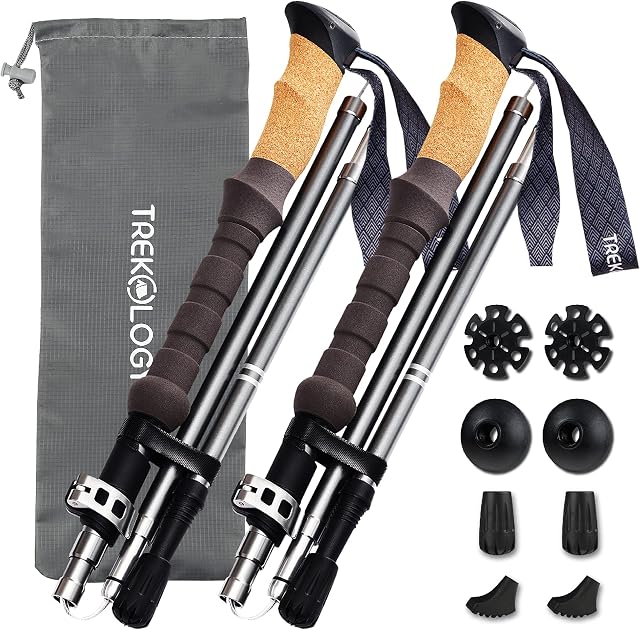
TREKOLOGY Trek-Z Cork Grip Trekking Poles
Amazon
- Design:
- Folding/foldable
- Material:
- Aircraft-grade aluminum
- Grip Type:
- Cork
- Packability:
- Compact travel design
- Adjustability:
- Adjustable height
What we like
- OutdoorGearLab 'Best Budget Pick' – independently tested against 19 other poles
- Cork grips absorb moisture and reduce hand fatigue on long hikes
- Folding design packs down compactly for travel and plane carry-on
- 7,000+ reviews at 4.5 stars demonstrates consistent buyer satisfaction
Worth knowing
- Aluminum construction adds weight compared to carbon fiber models
- Folding design has more potential failure points than telescoping poles
- Not ideal for heavy loads or aggressive backcountry use
Rated OutdoorGearLab's 'Best Budget Pick' after independent testing against 19 other poles, the TREKOLOGY Trek-Z is the aluminum starting point for most casual hikers. Cork grips manage moisture on long days, and the folding design stows compactly for travel or plane carry-on. The trade-off is the folding mechanism – more connection points than a telescoping design – and the expected weight premium over carbon.
Reliable Mid-Range Aluminum: Premium Foldable Hiking Poles by USA Brand

Premium Foldable Hiking Poles by USA Brand
Amazon
- Design:
- Foldable
- Material:
- Aircraft aluminum
- Grip Type:
- Cork and EVA foam
- Lock Type:
- Metal flip locks
- Adjustability:
- Adjustable
What we like
- High 4.6-star rating across 2,300+ reviews – strong mid-budget performance
- Metal flip locks more durable than plastic alternatives at this price point
- Dual grip options (cork + EVA foam) for varied hand placement preferences
- Foldable design packs down smaller than telescoping poles
Worth knowing
- Aluminum construction – heavier than carbon fiber options
- Fewer reviews than top-tier budget competitors like TrailBuddy
- Brand identity unclear – 'USA Brand' marketing may concern some buyers
The Premium Foldable Hiking Poles stand out at this price tier for using metal flip locks rather than plastic alternatives, which matters for cold and wet conditions where plastic mechanisms are more prone to failure. The dual cork and EVA foam grip setup handles varied hand positions on long days. The anonymous brand identity is a legitimate concern for anyone who values warranty support.
Budget Carbon Option: 100% Carbon Fiber Trekking Poles by USA Brand

100% Carbon Fiber Trekking Poles by USA Brand
Amazon
- Design:
- Collapsible
- Material:
- 100% carbon fiber
- Grip Type:
- Cork and EVA foam
- Lock Type:
- Quick adjustable flip locks
- Adjustability:
- Adjustable height
What we like
- Carbon fiber construction at under $60 – exceptional value for the material
- 4.7 stars across 3,200 reviews demonstrates sustained quality at this price
- Quick flip locks allow fast length adjustments on the trail
- Dual grip (cork + EVA foam) provides moisture management and comfort
Worth knowing
- Carbon fiber can shatter/snap under lateral impact rather than bending like aluminum
- Generic 'USA Brand' branding lacks brand support infrastructure of LEKI or Black Diamond
- Limited warranty information available
Carbon fiber at under $60 with 4.7 stars across 3,200 reviews is hard to dismiss. The 100% Carbon Fiber Trekking Poles by USA Brand deliver the weight savings that justify carbon for weight-conscious hikers, with quick flip-lock adjusters that are more reliable than plastic twist-locks. The caveat applies to every budget carbon pole: no brand infrastructure means no reliable warranty, and the snap-not-bend failure mode doesn't change because the price is low.
High-Volume Budget Carbon: Trekking Poles – Carbon Fiber Walking or Hiking Sticks

Trekking Poles - Carbon Fiber Walking or Hiking Sticks with Quick Adjustable Locks
Amazon
- Design:
- Collapsible
- Material:
- Carbon fiber
- Lock Type:
- Quick adjustable locks
- Adjustability:
- Adjustable height
What we like
- 6,400+ reviews at 4.6 stars – one of the most-reviewed carbon poles in the mid-range
- Amazon's Choice designation validates broad buyer satisfaction
- Carbon construction at $65 undercuts most branded carbon poles by 50%+
- Quick adjustable locks allow terrain-specific height changes without tools
Worth knowing
- Anonymous branding limits accountability for warranty or customer support
- Carbon fiber will snap rather than bend if caught sideways in a fall
- Limited spec detail makes feature comparison with named brands difficult
With 6,400+ reviews at 4.6 stars, these carbon fiber hiking sticks represent one of the most reviewed carbon poles in this price bracket. At $65, they undercut most named-brand carbon options by 50% or more. The anonymous branding is a recurring limitation – no accountability for warranty claims – but the review volume provides reasonable proxy evidence of sustained quality.
Best Branded Aluminum: Black Diamond Trail Trekking Poles

Black Diamond Trail Trekking Poles (Aluminum)
Amazon
- Season:
- All-season design
- Material:
- Lightweight aluminum
- Grip Type:
- Natural, cork, or foam (variant-dependent)
- Lock Type:
- FlickLock adjustable
- Adjustability:
- Adjustable length
What we like
- Black Diamond's FlickLock mechanism is widely regarded as the most reliable locking system on the market
- 595 reviews at 4.6 stars demonstrates consistent satisfaction across a large sample
- All-season design with multiple grip options for different climates and preferences
- Black Diamond's brand reputation and 2-year warranty provide reliable support
Worth knowing
- Aluminum construction makes these heavier than Black Diamond's carbon offerings
- At ~$98, priced similarly to lighter carbon alternatives from lesser-known brands
- FlickLock adjustment requires stopping to re-lock – less convenient than twist-lock on the move
The Black Diamond Trail Trekking Poles represent the case for branded aluminum: FlickLock reliability, a 2-year warranty with actual support infrastructure, and all-season design with cork or foam grip options. R/hiking users consistently cite Black Diamond alongside LEKI as the two most-trusted brands for all-around reliability. The weight premium over carbon is real, but you get a known failure mode and a warranty you can actually use.
Entry-Level Black Diamond: Black Diamond Trail Back Trekking Poles
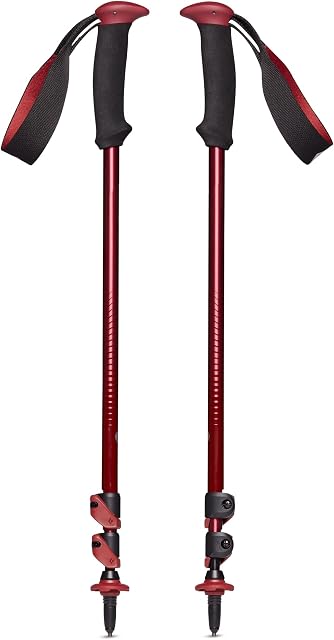
Black Diamond Trail Back Trekking Poles
Amazon
- Design:
- 3-section telescoping
- Material:
- Durable aluminum
- Grip Type:
- Comfortable grip
- Lock Type:
- FlickLock adjustable
- Intended Use:
- Hiking and backpacking
What we like
- Black Diamond brand quality with FlickLock reliability at a more accessible $70 price point
- Entry point into the Black Diamond lineup for hikers not ready to invest in carbon
- FlickLock system inherited from premium BD models ensures secure length adjustment
- Durable aluminum construction handles rocky and technical terrain reliably
Worth knowing
- Relatively low review count (148) compared to top-tier Black Diamond models
- Aluminum adds weight vs. Black Diamond's carbon Distance Z at only $50 more
- Fewer grip and basket options than higher-end Black Diamond Trail poles
The Black Diamond Trail Back gives hikers the FlickLock system and Black Diamond brand accountability at around $70 – roughly $50 less than the Distance Z carbon poles. For hikers not yet committed to paying for carbon, this is the cleanest entry point into the Black Diamond lineup. The 3-section telescoping design handles rocky and technical terrain without the snapping risk that comes with budget carbon.
Best Carbon for Trail Runners: Black Diamond Distance Z Trekking Poles
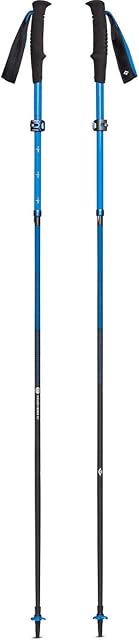
Black Diamond Distance Z Trekking Poles
Amazon
- Design:
- Foldable Z-pole
- Material:
- Carbon fiber
- Intended Use:
- Trail running and hiking
- Weight Class:
- Ultralight
- Adjustability:
- Fixed length (size-based selection)
What we like
- Ranked #1 by iRunFar for trail runners and ultrarunners – the top expert endorsement in that category
- OutdoorGearLab 'Best Value' pick among all poles tested across nearly 70 pairs since 2012
- Z-pole foldable design deploys and collapses rapidly – ideal for run-hike intervals
- Carbon construction keeps weight minimal for fast-and-light applications
- Also top-ranked by TheBigOutside among premium ultralight options
Worth knowing
- Fixed-length Z-pole design cannot be adjusted mid-hike for terrain changes
- Higher price point ($120–$175 depending on color/size variant)
- Lower review count on individual ASINs due to color/size variant splitting
- Not ideal for casual hikers who want adjustable length for varied terrain
Ranked #1 for trail runners and ultrarunners by iRunFar and named OutdoorGearLab's 'Best Value' across nearly 70 pairs tested since 2012, the Black Diamond Distance Z is the clearest recommendation for anyone who runs trails or fast-packs. The folding Z-pole design deploys and collapses rapidly, carbon keeps the swing weight low, and the Black Diamond brand provides real warranty support. The fixed-length design is a genuine limitation – it's not the pole for hikers who adjust frequently on varied terrain.
Women-Specific Ultralight Carbon: Black Diamond Women's Distance Carbon FLZ

Black Diamond Women's Distance Carbon FLZ Trekking Poles
Amazon
- Design:
- Foldable
- Material:
- Carbon fiber
- Length Range:
- 95–110 cm (women-specific)
- Weight Class:
- Ultralight
- Adjustability:
- Adjustable length (FLZ system)
What we like
- Women-specific sizing (95–110 cm) avoids the common 'unisex pole too long' problem for shorter hikers
- FLZ (FlickLock Z) combines the packability of a folding pole with FlickLock adjustability – best of both systems
- Carbon fiber keeps weight minimal for women seeking ultralight setup
- 4.7-star rating, though from limited review sample
Worth knowing
- Only 11 reviews – insufficient data to draw firm conclusions about long-term reliability
- Premium price ($175) for a women-specific niche product
- Narrow size range (95–110 cm) won't suit taller women hikers
The Women's Distance Carbon FLZ solves a genuine fit problem – unisex poles that run too long for shorter hikers – with a women-specific length range of 95–110 cm. The FLZ mechanism combines folding packability with FlickLock adjustability, which is the best mechanical combination available in a folding pole. At only 11 reviews, there's insufficient data to make firm long-term reliability claims, but the pedigree of the design is strong.
Premium Folding Carbon: Ultratrail FX.One Trekking Poles

Ultratrail FX.One Trekking Poles
Amazon
- Design:
- Foldable
- Material:
- Carbon fiber
- Intended Use:
- Hiking and trail running
- Weight Class:
- Ultralight
- Adjustability:
- Adjustable
What we like
- 4.7 stars across 225 reviews – strongest review count and rating combination among premium foldable poles
- Foldable carbon design optimized for both hiking and trail running versatility
- Ultralight construction suits fast-packing, thru-hiking, and ultrarunning use cases
- Premium build quality reflected in consistent high ratings at significant review volume
Worth knowing
- At $220, among the most expensive poles in the entire category
- Similar performance to Black Diamond Distance Z at roughly $50 more
- Lesser brand recognition than Black Diamond or LEKI among mainstream hikers
The Ultratrail FX.One holds the strongest review-count-and-rating combination among premium foldable poles: 4.7 stars across 225 reviews at $220. It's designed explicitly for hiking and trail running versatility. The honest comparison: the Black Diamond Distance Z delivers similar performance at roughly $50 less and carries more expert endorsements. The Ultratrail earns consideration if you want a premium alternative to Black Diamond's ecosystem.
Best Warranty: LEKI Makalu FX Carbon AS Trekking Poles

LEKI Makalu FX Carbon AS Trekking Poles
Amazon
- Design:
- Foldable/collapsible
- Material:
- Carbon fiber
- Weight Class:
- Lightweight
- Adjustability:
- Adjustable
- Brand Warranty:
- Lifetime warranty
What we like
- LEKI's lifetime warranty applies to this model – strongest warranty in the category
- 4.6 stars across 123 reviews demonstrates quality consistency at the premium tier
- LEKI's SpeedLock Plus system allows rapid length adjustment with one hand
- Foldable carbon construction balances packability with premium trail performance
Worth knowing
- At $249, the most expensive pole in our research – hard to justify over Black Diamond Distance Z at $120–$175
- Lifetime warranty only valuable if LEKI honors international/long-term claims
- Premium price puts it out of reach for most recreational hikers
The LEKI Makalu FX Carbon AS is the lifetime warranty argument made in pole form. R/hiking users explicitly cite LEKI's lifetime warranty as the reason to choose LEKI over Black Diamond despite the higher price. The SpeedLock Plus system allows rapid one-hand length adjustment, and the foldable carbon construction is well-suited for travel-focused hiking. At $249 it's the most expensive pole in this group – whether the warranty premium makes sense depends on how frequently you hike and how hard you use gear.
Legacy Premium Carbon: Black Diamond Alpine Carbon Cork Hiking Poles

Black Diamond Alpine Carbon Cork Hiking Poles
Amazon
- Material:
- Carbon fiber
- Grip Type:
- Cork
- Lock Type:
- FlickLock
- Adjustability:
- Adjustable telescoping
- Product Status:
- Discontinued (new model available)
What we like
- r/hiking users report 8+ years of regular use in excellent condition – exceptional long-term durability
- 405 reviews at 4.5 stars is the highest review count among premium carbon poles found
- Natural cork grips provide superior moisture management and custom hand molding over time
- Black Diamond FlickLock system on this model is trusted for alpine and technical terrain
Worth knowing
- Discontinued – Black Diamond's product page returns 404 errors; successor model recommended instead
- Original model had a design flaw: tiny separate hex key for FlickLock adjustment that users frequently lose (newer version has hex key incorporated into shaft)
- At $230, one of the most expensive poles, now without manufacturer support for this version
- Discontinuation means future parts availability is uncertain
The Black Diamond Alpine Carbon Cork poles are discontinued, and Black Diamond recommends newer models instead. However, they deserve mention here because r/hiking users report these poles surviving 8+ years of regular use in excellent condition – the longest track record among any carbon poles in the research. If you already own a pair, they're proven durable. If you're shopping new, this model is no longer available with manufacturer support, making it a poor choice despite its exceptional real-world longevity data.
Also Worth Considering

Cressida FX Carbon Collapsible Trekking Poles
Amazon
- Design:
- Collapsible
- Material:
- Carbon fiber
- Intended Use:
- Trekking and hiking
- Weight Class:
- Lightweight
The Cressida FX Carbon is an Amazon's Choice collapsible carbon pole at $165, sitting between budget carbon and branded premium options. With only 68 reviews, there isn't enough long-term community data to make a strong recommendation over the Black Diamond Distance Z, which carries far more expert endorsements at a similar price point.
Frequently Asked Questions
- Do carbon fiber trekking poles really snap that much more often than aluminum?
- In real-world conditions, yes – but the failure mode matters more than frequency. Carbon fiber is very strong under axial (vertical) load but fractures under lateral impact rather than bending. A blogger at csinstant.coffee documented shattering multiple name-brand carbon poles in a single season through routine hiking, while their aluminum backups survived the same conditions intact. Aluminum poles bend or dent but remain structurally usable after lateral stress. The risk is higher on technical terrain, during falls, or on steep descents where you're loading poles asymmetrically.
- Is FlickLock actually better than twist-lock, or is it just marketing?
- The mechanical difference is real. Twist-lock systems rely on internal friction, which degrades in cold weather, with dirt contamination, and after heavy use cycles. FlickLock uses an external lever-cam that provides a visible locked/unlocked indicator, works with gloves, and is field-repairable. Industry testing shows twist-locks need replacement after heavy use, while FlickLock mechanisms can be serviced in the field. R/hiking users confirm FlickLock reliability as a key reason to choose Black Diamond. LEKI's SpeedLock Plus operates on a similar external-lever principle.
- How long do trekking poles actually last with regular use?
- Longer than most reviews suggest. R/hiking users have documented Black Diamond Alpine Carbon Cork poles surviving 8+ years of regular use in excellent condition. Quality aluminum poles using 7075-T6 alloy often outlast cheaper carbon models through durability rather than catastrophic failure, according to ClevHiker's data across 38 thru-hikes. Budget carbon poles from anonymous brands carry no community track record and are more likely to fail earlier under hard use. Premium branded carbon or aluminum from Black Diamond or LEKI, used appropriately for the terrain, can last 8 years or more with proper use.
- Do trekking poles help with knee pain on descents?
- Yes, and the mechanism is well-documented. Lengthening poles by 5–10 cm on downhill sections creates a braking effect that transfers load from your knees to your arms, according to REI's expert advice. TheBigOutside author Michael Lanza, with 25+ years of field experience, specifically cites joint relief and leg strain reduction as primary pole benefits. R/hiking users list weight transfer on downhill sections as one of the five core pole advantages. The benefit applies on moderate terrain, not just technical descents.
- What height should I set my trekking poles?
- Start with your elbows at 90 degrees when holding the grips with tips flat on the ground. From there, shorten by 5–10 cm for sustained uphill sections to maintain posture, and lengthen by 5–10 cm for downhill to offload your knees. REI's expert advice notes adjustable poles range from approximately 24 to 55 inches. LEKI offers a free pole length advisor tool at leki.com if you want a precise starting point based on your height.
- What's the difference between folding and telescoping trekking poles?
- Telescoping poles use a twist-lock or flick-lock mechanism to extend and retract continuously – useful for hikers who change terrain frequently or share poles. Folding poles collapse into sections (typically 3) connected by an internal cord, deploying faster but with no mid-hike length adjustment. iRunFar specifically recommends folding poles for trail runners because stow and deploy speed matters during run-hike transitions. For general hiking, telescoping offers more terrain versatility; for trail running or fast-packing, folding wins on packability and speed.
- Is LEKI's lifetime warranty worth paying extra for over Black Diamond's 2-year warranty?
- It depends on how frequently you hike and your price tolerance. R/hiking users debate this directly: some argue that poles lasting 8+ years anyway make the warranty delta irrelevant; others note that for a $249 carbon pole used heavily, a lifetime warranty has real monetary value if something fails outside Black Diamond's 2-year window. The honest answer is that for casual hikers, the warranty premium likely isn't worth it. For frequent backpackers and thru-hikers who use poles hard, LEKI's lifetime coverage provides meaningful peace of mind.
- Which trekking poles are best for trail running specifically?
- iRunFar, which tested 12+ poles specifically for runners and ultrarunners, ranked the Black Diamond Distance Z Carbon as #1. The key features for running poles are ultralight weight, fast-deploy folding design (3-section Z-pole), compact stow size when not in use, and wrist straps that allow quick transfers between hands. OutdoorGearLab also designated the Distance Z as 'Best Value' overall. The Ultratrail FX.One at $220 is a premium alternative with strong ratings (4.7 stars, 225 reviews) designed explicitly for hiking and trail running use.
- Can trekking poles be used as tent poles?
- Yes, and this is a well-established ultralight backpacking technique. Many ultralight shelters from brands like Zpacks, Gossamer Gear, and Big Agnes are designed specifically to use trekking poles as their primary support structure. This dual-use approach is mentioned as a weight-saving benefit by TheBigOutside and ClevHiker. The technique favors adjustable telescoping poles over fixed-length folding poles, since shelter heights often require specific length settings.
- Cork, foam, or rubber grips – which is best?
- Cork grips absorb moisture, reduce odor, and mold to your hand's shape over time – best for long-distance hiking and warm conditions. EVA foam grips are softer, lighter, and better insulating – good for cold conditions and extended grip positions. Rubber grips are durable in cold weather but can cause hand irritation in warm conditions due to reduced breathability. Most premium poles use cork. Many poles combine a cork upper grip with an EVA foam extended grip below for varied hand positions on long climbs.
Related articles